
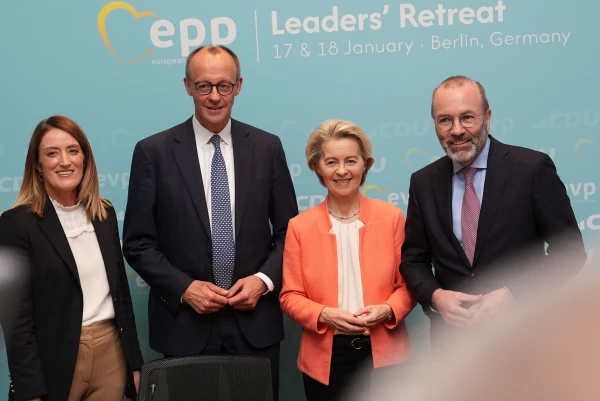
The head of the federal government wants to restore Germany's military potential.
Eight months have passed since Friedrich Merz (70) was elected Chancellor of Germany — just a short time. However, during this period, his government has already been on the brink of collapse twice, and the personal approval rating of the head of the cabinet has fallen to a record low.
Crisis among the "Black-Red" Coalition
It is worth remembering that the vote in the Bundestag for Merz's candidacy for the chancellorship at the beginning of May was catastrophic — he was elected only in the second round, which has never happened in the history of the Federal Republic of Germany. Moreover, there were signs of a possible fiasco in the first round, but for some reason, Merz chose to ignore them and was confident of victory. Such a start to his rule should have cooled his ardor and served as a bitter lesson for the new chancellor; however, throughout the year, Merz repeatedly found himself in situations that led him into a dead end. It is difficult to say why this is happening — whether the chancellor believes in the unshakeability of his authority in the party and the country, or relies on the wrong advisors and confidants.
In July, Merz misjudged the mood within the faction of the Christian Democratic Union and the Christian Social Union (CDU/CSU) during the procedure for appointing judges to the Federal Constitutional Court. Despite agreements in the ruling coalition (CDU, CSU, and the Social Democratic Party of Germany), conservatives unexpectedly opposed the SPD candidate, Frauke Brozius-Gersdorf, shortly before the vote, partly due to her stance on abortion. The Social Democrats were beside themselves, and the first cracks appeared in the coalition.
At the end of the year, the ruling alliance faced another serious crisis: a group of young deputies in the CDU/CSU faction opposed the (coalition-agreed) pension reform, thereby calling its adoption in the Bundestag into question. Merz again failed to take into account the positions within his own ranks.
The Merz-Macron Tandem Cracks
The positions of Germany and France diverged both on financial aid to Ukraine and on the issue of signing an agreement with MERCOSUR. While the chancellor insisted on quickly concluding agreements with South American countries and even claimed that all objections in the EU had allegedly been lifted, the French president was maneuvering in light of massive farmer protests in his homeland against the agreement.
The German-French project for a new European fighter jet, FCAS, is on the verge of failure. At the end of August, Merz and Macron promised to resolve the disagreements between manufacturers Dassault and Airbus by the end of the year, but this did not happen. Thus, Reuters reported, citing sources, that the implementation of the project is "extremely unlikely."
Given that the domestic political positions of both Merz and Macron are weakened, it is possible that each will try to stand out more on the European "stage."
Militarization Amid Stagnation
The German authorities are investing billions of euros in the defense industry and purchasing weapons for Ukraine — despite the significant difficulties facing the German economy. The Rheinmetall group reports new arms orders or the signing of new agreements almost weekly, while the German automotive industry has lost about 50,000 jobs in just one year, and an unprecedented wave of bankruptcies has swept the country.
Warnings from analysts and economic associations about the threat of prolonged stagnation in the German economy seem to go unheard by Merz, and there are more than enough of them.
For example, the mayors of the administrative centers of 13 out of 16 federal states of Germany (excluding city-states — Berlin, Hamburg, and Bremen) warned the chancellor back in late October that municipalities had reached the limit of their financial capabilities. The deficit in the budgets of cities and communities this year reached a record level since the reunification of the country — €24.8 billion.
The Federation of German Industries (BDI) pointed out that the German economy is experiencing a historic, possibly the most serious crisis in the entire existence of the republic. According to BDI head Peter Leibinger, a production decline of 2% is expected by the end of the year, marking its contraction for the fourth consecutive year. Meanwhile, the Employers' Association of the Metal and Electrical Industries (Gesamtmetall) predicted the loss of tens of thousands of jobs in its sectors by 2026.
At the same time, the problems of the German economy (traditionally export-oriented) are generally evident. Along with bureaucratic barriers, there are high energy prices amid the abandonment of Russian gas, fierce competition from organizations in China (especially in the automotive sector), and trade tariffs imposed by U.S. President Donald Trump. Germany faces the threat of recession for the third consecutive year.
While Merz promises to make the Bundeswehr the strongest conventional army in Europe, the country's economy is losing its former strength.
A Decisive Year for Merz
The initial position for the "Black-Red Coalition" was not bad — the German government could calmly work on legislation in 2025 without fearing electoral upheavals and serious inter-party struggles. In 2026, everything changes: elections will be held in the state parliaments of five regions (Baden-Württemberg, Mecklenburg-Vorpommern, Rhineland-Palatinate, Saxony-Anhalt, and Berlin). These elections will serve as a test of strength for Merz's cabinet.
In Rhineland-Palatinate (elections scheduled for March 22), the SPD has ruled for 34 years and may lose the position of prime minister for the first time in these years. It is possible that the SPD will attribute its defeat to the policies pursued by the federal government, which in turn threatens to exacerbate disagreements within the coalition.
The elections in two East German states are likely to be crucial. In Saxony-Anhalt (September 6), the Alternative for Germany (AfD) could achieve an absolute majority and elect a prime minister from its ranks for the first time. This would not only be a blow to the federal government but promises to change the entire political landscape in Germany. Even if the AfD does not achieve an absolute majority, the situation in Saxony-Anhalt will clearly be a stalemate for the ruling bloc after the elections. The Christian Democrats in the region exclude cooperation with both the AfD and the Left Party. And without the latter, they cannot form a coalition without the AfD.
In Mecklenburg-Vorpommern (September 20), the AfD's rating is around 40%, significantly ahead of the second-place Social Democrats. Again, the Left Party is necessary to create a ruling coalition in the region without the AfD. Thus, the conservatives are breaking the taboos they had set for themselves.
As experience shows, during state elections, candidates sacrifice many of their parties' positions that seem unshakeable at the federal level. During the election campaigns in Saxony-Anhalt and Mecklenburg-Vorpommern, topics such as relations with Russia and the resumption of energy supplies from the RF, the resolution of the conflict in Ukraine, and arms to Kyiv will clearly be on the agenda.
From election to election, the pressure on Merz, including within his own party, will only increase. Whether his cabinet will be able to implement the promised social reforms under these conditions or whether disagreements between conservatives and Social Democrats will escalate — much will depend on the results of the upcoming elections in the states.
What is Merz's Personal Problem
For the first time, the young lawyer Merz became a deputy, and immediately — a Member of the European Parliament in 1989 — he was only 34 at the time.
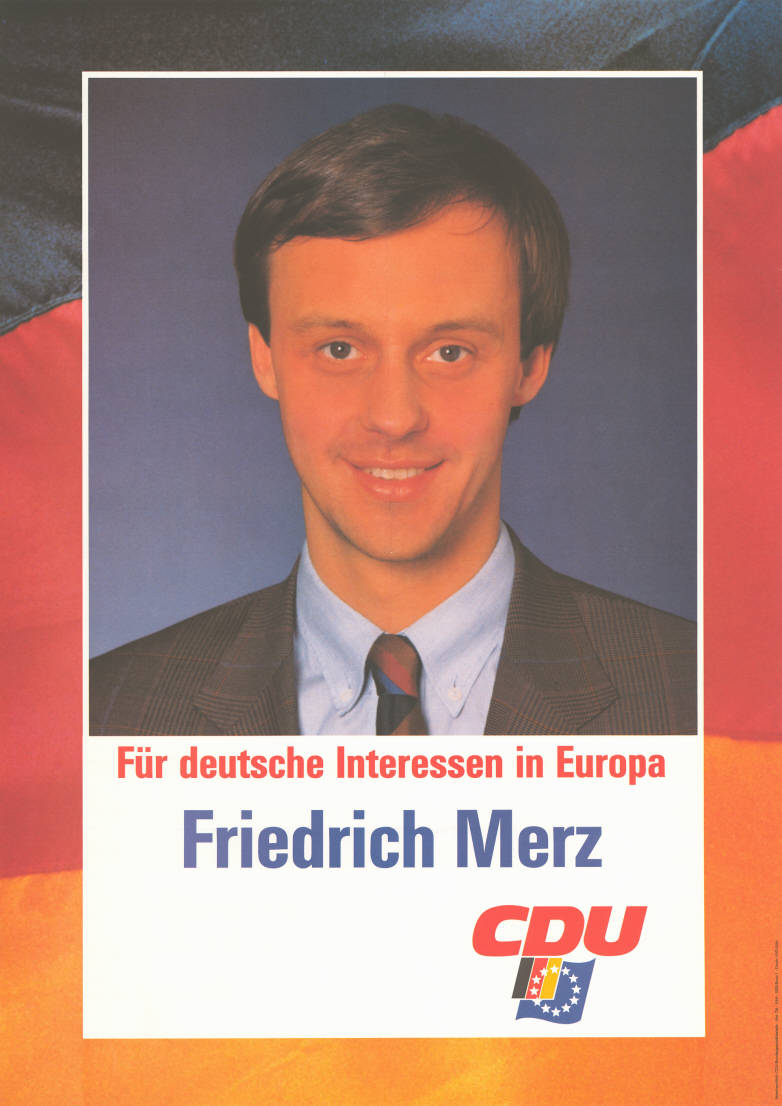
Friedrich Merz's popularity rating is now even lower than that of his predecessor, Olaf Scholz, at the end of his term, standing at around 22%. Since about August, support for the CDU/CSU bloc has also "frozen" at one level. There are no signs that this will change in the near future and that Merz will reverse the trend in his favor.
Many experts have repeatedly pointed out that the chancellor has repeatedly violated his own promises and taboos. Some of his statements have been striking but so thoughtless that they sometimes caught not only partners but also ordinary citizens off guard. It is enough to recall how he once made openly racist remarks, calling young people of Arab descent "little pashas."
The list of Merz's verbal "blunders" — there is no other way to put it — can be continued. His statement about military service will be long remembered: he said that "the world is present in every cemetery."
The chancellor's speeches also lead to diplomatic dissonance. After a brief visit to COP-30 (the UN climate change convention), he managed to provoke outrage in Brazil and devalue his visit. Merz then made a dismissive remark about Belém — the capital of the Brazilian state of Pará.
"I asked some journalists who were with me in Brazil who among them would like to stay there? And no one raised their hand," the chancellor stated. "They were all glad to be back in Germany from where they were," he claimed. Merz, as head of the German government, has clearly expressed ambitions to become a new leader in the EU. However, the last EU summit has, at least for the foreseeable future, dashed these plans and shown that the new chancellor still has much to learn. Is Merz capable of this? For now, his behavior suggests otherwise.








Leave a comment