
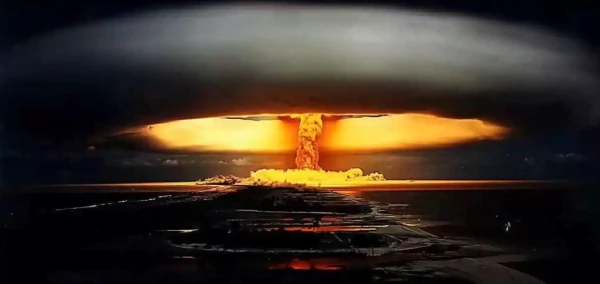
From a doctrinal perspective, this would be a complete repetition of the strategic bombings of World War II.
In the 1950s, nuclear war was seen by strategists and politicians not as an apocalypse to be avoided at all costs, but as one of the possible scenarios. In the USA and the USSR, people were making lists and drawing maps, searching for ways to achieve victory in a new global conflict. Soviet plans from that era remain secret, while in America, in 2015, an 800-page document from 1956 detailing plans for bombing Soviet, Chinese, German, and Polish cities was declassified.
The declassified document is titled "Study of SAC Nuclear Armament Requirements." SAC stands for the Strategic Air Command of the U.S. Air Force, the operator of long-range bombers and the primary operator of atomic bombs during that era. Given that the document concerns plans and target selection for nuclear bombing, its title may be misleading.
In the early 1950s, SAC categorized all targets in the upcoming nuclear war into three categories: Soviet nuclear forces (code "Bravo"), conventional forces ("Romeo"), and urban-industrial centers ("Delta"). Historically, since World War II and based on its practices, SAC preferred "Delta" targets, as attacks on the industries of Germany and Japan had nearly led to the collapse of their military potential. However, the emergence of a significant stockpile of nuclear weapons in the USSR fundamentally changed priorities.
The 1956 document gives absolute priority to aviation targets, which included targets from all three categories. "The necessity to win the war in the air is absolutely decisive compared to all other considerations," the document states. At the same time, the only effective strategy was considered to be blitzkrieg, elevated to an absolute form. Planners explicitly wrote that the presence of nuclear weapons on both sides creates a factor of "severely compressed time": if the shot (bomb drop) equals the destruction of the target, then the one who shoots the most first will win. This led to requirements for strategic forces: to have more bombs and as powerful as possible, and to be able to deliver them as quickly as possible. The more damage inflicted on the enemy in the first hours, the greater the chances of ultimate victory.
Aviation targets included airfields, missile bases, headquarters, government institutions, nuclear weapon storage facilities, as well as aircraft factories, nuclear industries, and even fuel and lubricant depots.
Of the top 20 targets, all were airfields: four in Belarus, seven in Ukraine (including bases near Poltava, Zhytomyr, and Melitopol), six in Russia, and one in Estonia (Tartu). For each of them, particularly powerful bombs were prepared, up to 15 megatons, and they were to be detonated not in the air, but at ground level — to destroy the airfield with one hit and leave no chance for quick repairs. Many of the selected targets were located near cities, so such powerful explosions would inevitably cause mass casualties. For example, dropping a 15-megaton bomb on the airbases in Poltava or Tartu would have affected the cities with the fireball of the explosion.
Did this mean that American command planned to conduct a chivalric tournament between nuclear bombers, attacking only military targets in the event of war? That would be strange, as SAC was then commanded by General Curtis LeMay, who rejected humanitarianism in war outright. He became famous for his ingenuity in firebombing Japanese cities during World War II, and after the start of the Cold War, he considered the most correct strategy to bomb the USSR preemptively while it had little nuclear weaponry — at least, such rumors circulated about the general.
The prioritization of SAC was based not on moral considerations, but on purely practical ones: an atomic bombing of Moscow would lead to huge human casualties but would not affect the ability of the Soviet Air Force to deliver nuclear strikes. SAC command could be heartless, but it was not brainless, and thus killing for moral satisfaction did not make it onto their to-do list.
Moreover, Moscow and Leningrad were still included in the target lists, and in several categories. For instance, there were 12 airbases in Moscow, although none of them even made it into the top 400. Additionally, in the city and its surroundings were: seven storage facilities for Air Force equipment, an Air Force control point, one government facility (most likely the Kremlin), four missile production and research centers, five nuclear research centers, as well as the General Staff and the Ministry of Defense. There were not many fewer targets in Leningrad itself.
Finally, the list of SAC's priority targets concerned the first hours and days of the conflict, during which the war would either be won or lost. If American aviation managed to destroy all Soviet airbases and priority targets, but the USSR still did not surrender and was not defeated, the war would enter a protracted phase. For this, SAC also had a plan: "systematic destruction."
From a doctrinal perspective, this would be a complete repetition of the strategic bombings of World War II, but this time with atomic bombs. Aircraft would systematically destroy factories and plants most important to the military-industrial complex, and the ideal projectile for this was considered to be the 160-kiloton Mark 6 bombs — sufficient to destroy an industrial zone or urban area, but not a metropolis.
The list of industrial targets was not ranked by priority, but it included almost all major Soviet industrial enterprises.
Most likely, this refers to the doctrine of some generals from the 1940s, who believed that one of the goals of bombings was to break the morale of the enemy's population, which should crumble due to both casualties and material hardships. Such a principle of target selection was always officially rejected and not practiced, for example, in the Korean War.
However, considering that around 180 industrial and government facilities were designated for destruction in Moscow, there was no need to single out the "population" as a separate target. Casualties would be counted in the hundreds of thousands at a minimum, if by that time the Soviet government had not managed to conduct an evacuation.
The U.S. also had no intention of sparing the Poles, Romanians, and Germans — allies of the USSR in the Warsaw Pact. For example, the airfield near the German town of Oranienburg was on the list of targets for blitzkrieg at number 95. It is located 34 kilometers from Berlin, so the city would inevitably be affected by the shockwave of a 15-kiloton bomb. Similarly, the airfield in Brzeg, ranked 31st on the list, was located 40 kilometers from Wrocław.
Finally, in the event of the war transitioning to the phase of "systematic destruction," both Berlin and Warsaw, and even Beijing could be subjected to nuclear attack — it was unknown whether China would enter the war, but for good measure, SAC had also selected targets in it.











Leave a comment