
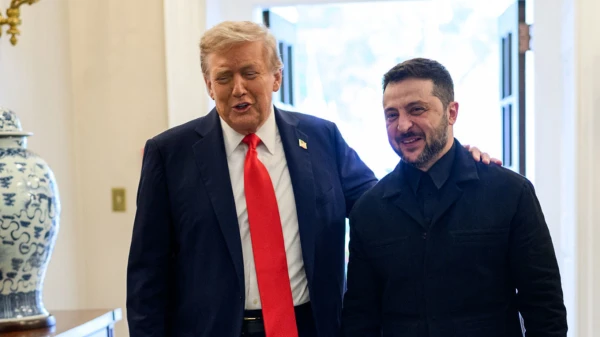
America promised to bring Ukraine into the European Union.
Despite the businesslike approach of Donald Trump's negotiators to such a delicate diplomatic issue as ending the war in Ukraine, and their willingness to establish relations with Putin's Russia, the plan being developed could serve as the basis for a real peace settlement, writes The Washington Post. Its main provisions include a Korean model of separation of the warring parties, protection of Ukraine's sovereignty and security, its accession to the EU by 2027, the return of the Zaporizhzhia Nuclear Power Plant to Ukraine, and the restoration of the economy using American, European, and frozen Russian funds.
"Here is a simple description of what peace in Ukraine should look like: a sovereign state, its borders protected by international security guarantees, entering the European Union and restoring its economy with large investments from the U.S. and Europe," writes David Ignatius, a foreign policy columnist for The Washington Post, citing participants in the negotiations. "Despite President Donald Trump's tough negotiating tactics and his inexplicable sympathy for the Russian aggressor, such a deal, judging by what I hear from American, Ukrainian, and European officials, seems increasingly realistic."
As an official from Ukraine told Ignatius, three documents are currently being discussed: a peace plan, security guarantees, and an economic recovery plan. Changes will be made to them; in particular, on Wednesday, Ukraine and its European allies plan to present some of them. Ignatius lists the main ideas being discussed, which he heard from officials in Ukraine and the U.S. this week.
-
Ukraine will join the EU by 2027. Washington believes it can overcome Hungary's resistance, whose government is currently categorically opposed to this. EU membership will promote trade development, investment, and the fight against corruption.
-
The U.S. will provide Ukraine with security guarantees similar to Article 5 of the NATO Charter. Kyiv insists that the U.S. sign such an agreement and ratify it in Congress; European countries will provide their own guarantees. The new U.S. national security strategy raises serious questions about Washington's willingness to provide military assistance in Europe in the event of another attack by Putin. But Trump's team assures that the U.S. is ready to continue providing Ukraine with intelligence, which is an essential condition for ensuring security.
-
Russia will have no veto power over Ukraine's sovereignty. However, the issue of the size of the Armed Forces of Ukraine is still under discussion. Kyiv refuses any formal constitutional limitation that Moscow insists on. But Ukraine may strengthen its defense with additional forces, such as the National Guard and others, officials believe.
-
A demilitarized zone along the entire line of ceasefire will resemble the one that separates North and South Korea. It will be closely monitored, and a deeper zone will be established behind it where the use of heavy weapons is prohibited.
-
The territorial issue remains one of the most contentious. Kyiv refuses to surrender unoccupied areas of Donbas to Russia. Trump's team argues that if the war continues, a significant part of them may still be lost, and it is better to make concessions now to avoid casualties. They proposed several formulations, including demilitarization of the areas handed over to Russia and treatment of the occupied territories according to the Korean model: South Korea still claims its legitimate right to the entire peninsula, as does the North.
-
The Zaporizhzhia Nuclear Power Plant will be returned to Ukraine. The U.S. proposal to place it under management is liked by some Ukrainian officials. The Trump administration will facilitate investments and economic development in Ukraine. Part of the frozen Russian reserves in Europe may be directed to these goals. American officials are negotiating with Larry Fink, the CEO of the world's largest asset management company BlackRock, about reviving the plan to create a Ukraine Development Fund. It was expected to attract $400 billion for recovery, with the World Bank participating in the project.




Leave a comment