
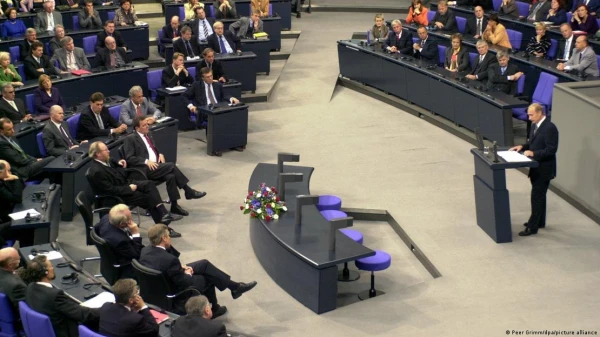
"To some extent, we wrote this speech for ourselves."
Documents from the German Foreign Ministry, intelligence agencies, and other departments, as well as accounts from experts, leave no doubt that Berlin had ample reasons to distrust Vladimir Putin during the 25 years he has been in power in Russia. However, German politicians ignored alarming signals right up until the start of the full-scale war by Russia against Ukraine, only increasing the dependence of the German economy on Moscow.
This is discussed in the book by German journalists Georg Mascolo and Katja Gloger titled "Failure: An Investigative History of Germany's Policy Towards Russia."
"Many of us, upon seeing this frail man with a gray face, wearing suits that did not fit him perfectly at the time, wondered: who is this Mr. Putin?" recalls Gloger. According to her, in the perception of many foreign journalists working in Moscow during the 2000s, Vladimir Putin had not yet taken a prominent place, "even though he had already been a central figure in the power system of the late Yeltsin period for several years."
At the beginning of his first presidential term, Putin sought to present himself as "a newcomer who wants to learn from the West," a role he played not only before the media but also in front of then German Chancellor Gerhard Schröder. "What is a savings agreement for building housing? How does Germany help students, how does the pension system work?" he asked. "This was a different, seemingly different, Putin," recalls the journalist, who is fluent in Russian. "But in reality, he was just trying to 'pull the wool over our eyes,' remaining a tough KGB officer."
Her husband Georg Mascolo, former editor-in-chief of the weekly Der Spiegel, known in Germany for his investigative journalism, adds: "When Putin first appeared on the political scene, many in the world knew very little about him. But in Germany, it was different. It was not only that Putin had extensive experience related to Germany, but also that Germany had significant experience related to Putin."
According to him, there were two camps in the German Foreign Ministry from the very beginning, depending on their attitude towards Putin. Some believed that, despite his past in the KGB, "after the agony of the Yeltsin era," he could be dealt with. Others, especially representatives of the intelligence services, warned: "Be careful. An intelligence officer remains an intelligence officer."
In one of the documents from the Federal Office for the Protection of the Constitution, which Mascolo and Gloger quote in their book, there was a note regarding the beginning of Putin's first presidential term: "A cynical officer of the KGB with deeply nationalist thinking." "Warning signals came very early, but they were ignored," states Mascolo.
Many remember Putin's speech in German in the German Bundestag in September 2001, which was enthusiastically received by the deputies. However, few know that in preparing for it, Putin sought the help of his close friend, former Stasi officer Matthias Warnig, who, in turn, consulted Horst Teltschik, a long-time foreign policy advisor to Chancellor Helmut Kohl. They formulated two key messages of the speech: "Russia is a friendly European country" and "Russia is a reliable business partner and is open to interesting deals."
"Many perceived it at the time as: the Russian president has come to us, addressing us in the language of Kant, Goethe, and Schiller, thus revealing his heart to us. But it was not quite that way," says Katja Gloger. "Because to some extent, we wrote this speech for ourselves." On the same day, Putin also spoke in the Bundestag's international politics committee, as this was a condition for his invitation to the Bundestag. "There was no trace of Kant, Schiller, and Goethe there," summarizes Mascolo the protocol of that meeting. "Instead, there were statements from Putin like: 'I am tired of your double standards'; 'We are tired of hearing your criticism over the war in Chechnya'; 'God bless NATO, but if they continue in the same spirit, there will be no united European house.'"
The murder of journalist Anna Politkovskaya in October 2006, the poisoning of former FSB agent Alexander Litvinenko in London with radioactive polonium in November 2006, the crash of the airliner over Donbass on flight MH17 in July 2014, the murder in Berlin of former Chechen field commander Zelimkhan Khangoshvili in August 2019...
"Putin's policy and his methods of dealing with Europe began to leave a bloody trail from the very early stages," notes Gloger, pointing out that against this backdrop, it would have been quite appropriate for Germany to undergo "several changes of era" long before the "change of era" announced by German Chancellor Olaf Scholz in February 2022, after the start of the full-scale war in Ukraine.





Leave a comment