
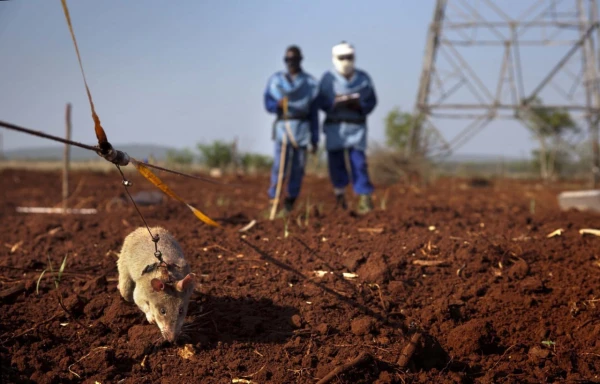
Mobilized rodents can live up to 8 years.
The use of landmines is widespread in African military conflicts. Remaining in the ground after the end of hostilities, landmines hinder the development of infrastructure and agriculture, not to mention the risk to the health and lives of the local population.
After lengthy consultations with scientists, the ambitious startup Vigens chose the Gambian pouched "hamster" rat, which is widely found in sub-Saharan Africa. It has "earned" its honorary mission due to its keen sense of smell, resistance to tropical diseases, and a long lifespan of 6-8 years. A critically important parameter is the weight of the rat — 1.5 kg compared to the 5 kg typically required to activate an anti-personnel mine.
In choosing the training method, Vigens was inspired by the work of Russian and Soviet physiologist Ivan Pavlov on conditioned reflexes. He used a clicker and rewards to show the rat the correctness of its actions. The animal's task was to identify the smell of explosives among other everyday scents.
Subsequently, based on the experiments, the organization Anti-Persoonsmijnen Ontmijnende Product Ontwikkeling ("Development of Anti-Personnel Mine Detection Products"), or APOPO for short, was created. The first mission of APOPO took place in 2007 in Mozambique. In the past, the organization has also conducted demining operations in Zimbabwe, Senegal, and South Sudan.
Since its inception, the range of "services" provided by APOPO's rats has expanded: in addition to demining, they are involved in smuggling detection, disease identification, and locating survivors after disasters. The demining mission operates in one African country — Angola, while the tuberculosis detection mission is active in Ethiopia.
The basic diet and daily care for one rat cost 12 euros per month. Considering all expenses related to training, evaluation, and care, the total preparation of one mine-detecting rat costs an average of 6000 euros.
The principle of operation for rats detecting tuberculosis is similar to that of deminers: the animal distinguishes a sick person from a healthy one by the smell of sputum. A meta-analysis of studies on the sniffing method has proven its effectiveness; however, it still does not meet current WHO standards and does not replace microscopy of smears. Scientists note that a rat can identify hundreds of samples in less than 20 minutes, while a qualified microscopy specialist takes 4 days to complete the task. They suggest that sniffing could become an effective "first-line" method due to its cost-effectiveness and speed.
Great hopes are also placed on rats in the fight against smuggling. Last year, sniffer rats were sent to the port of Dar es Salaam in Tanzania. The rodents successfully detected over 83% of hidden targets, even when they were masked by other smells. Among the illegal goods identified by the rats are rhino horns, pangolin scales, blackwood, and ivory.















Leave a comment