
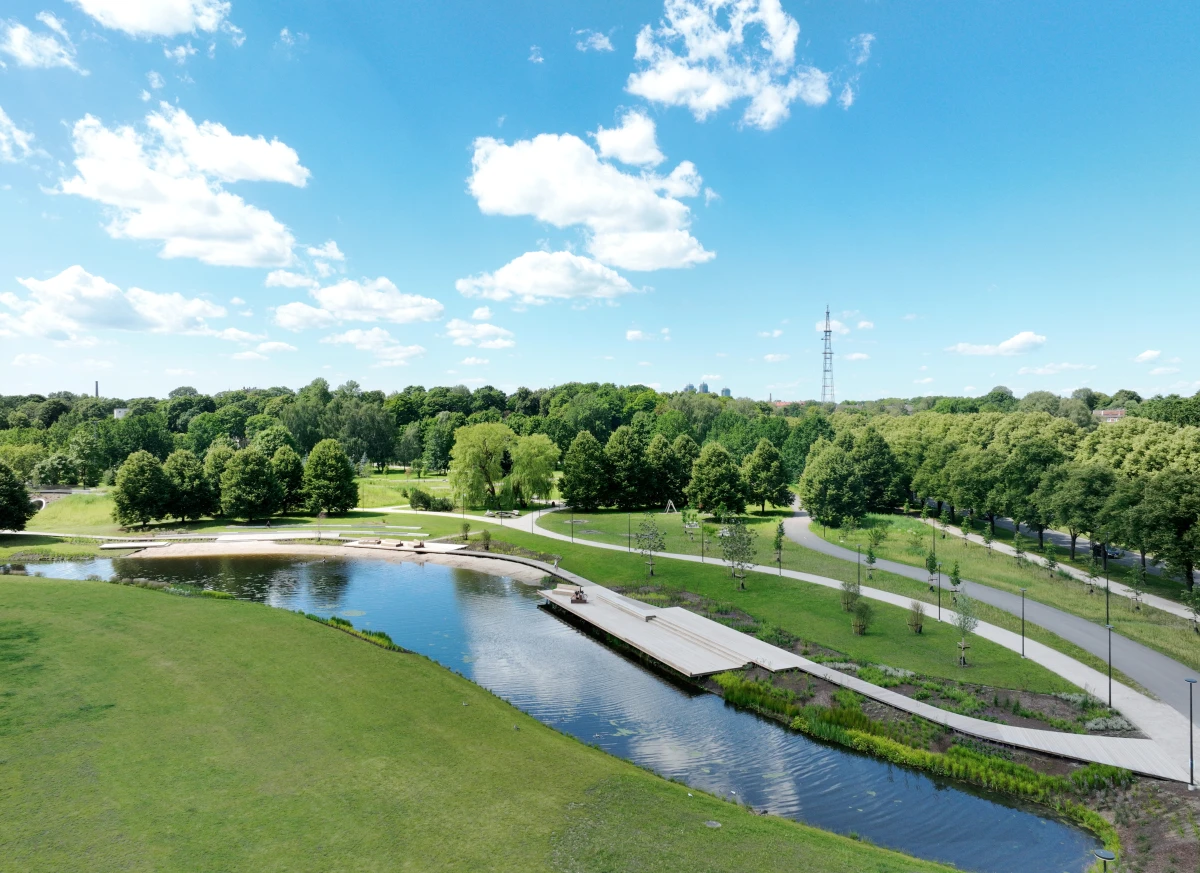
Uzvaras Park (Victory Park) is one of the youngest in the capital, as its landscape portrait was painted in the early 2020s, against the backdrop of dramatic political battles. At the same time, it is truly a traditional place for city residents to relax, and its modern appearance likely existed in the dreams of high-ranking gentlemen of the past!
From Monument to Picnic
When approaching the park today, one's eyes inevitably search for signs of the past – at least something reminiscent of the era from 1985 to 2022, when the vertical dominant was the concrete obelisk to the Liberators of Riga with its sculptural composition. No, there is nothing. However... If you delve deeper, on the left side, you can find a small building constructed in the style of socialist modernism. Now it serves as a rental facility.
In principle, everything has changed here – including the water body, which was drained after the monument was dismantled, killing the fish that lived there.
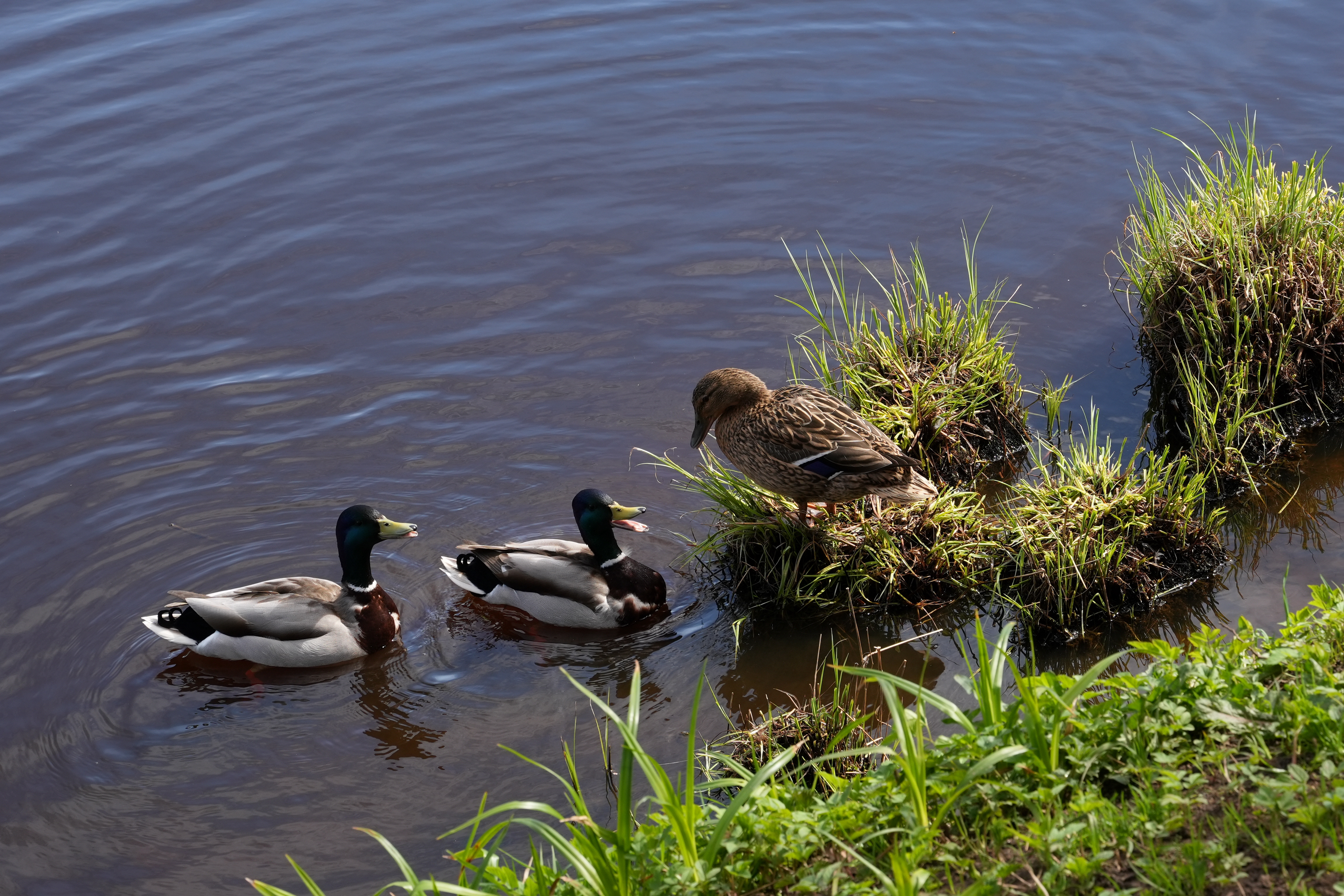
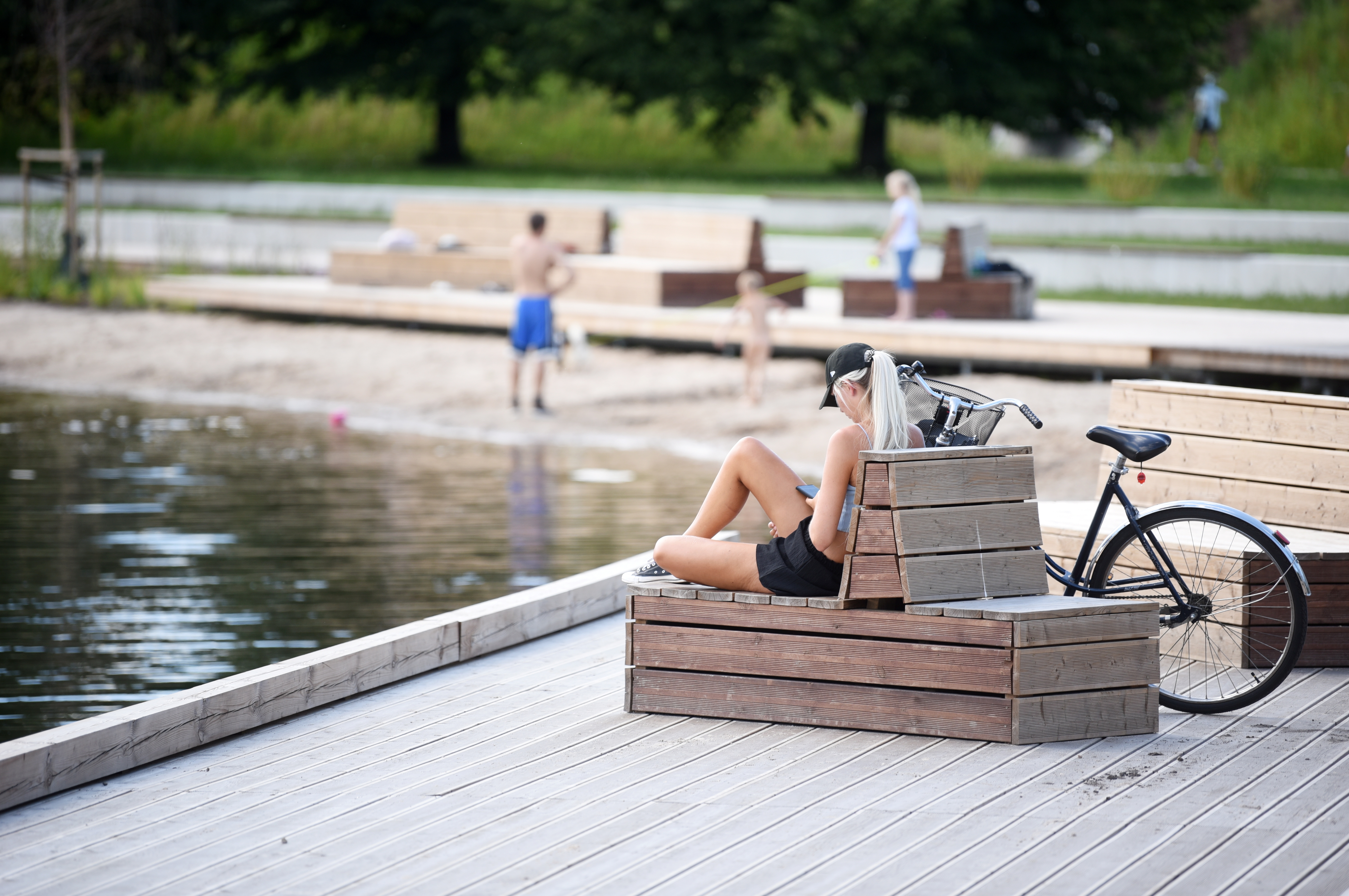
Today, nature dominates in Uzvaras Park: ponds overgrown with sedge and reeds, where important ducks, drakes, and coots with black-and-white heads take their strolls on the lawns. There, they coexist with neatly resting groups of children and youth on the grass. In general, there is a sense of tranquility everywhere. The landscape after the battle.
LETA
In the active recreation area, teenagers zip around on sports bikes and jump on boards. There is also a clever water-mechanical structure, a system of swings and pumps, through which one can trace the path of water. In the distance, there is a wooden slide with various amusements for toddlers, and for adults and children, a round pavilion of a popular establishment in Riga known as the "hedgehog". The prices are not too prickly.
LETA
Your author can attest – the efforts of the municipal company Rīgas meži have borne fruit, and after almost four years, the residents of Riga have received a full-fledged park that essentially created a single green mass, uniting the spaces of Arcadia; the plantings by the Maras pond; and that part of Uzvaras Park where cherry blossoms bloom, opposite which stands a panoramic wheel. Pardaugava can be said to be the most park-like district of Riga!
In the Name of Peter, by the Hands of Nicholas
Meanwhile, nothing is done in a vacuum! For the decision to establish the park was made back in 1909, in anticipation of the large-scale celebration of the two-hundredth anniversary of Riga's actual incorporation as the capital of Livonia into the Russian Empire (on July 4, 1710, the troops of Russian General Field Marshal Boris Sheremetev captured Riga after approximately an eight-month siege, one of the best-defended fortresses in Swedish Livonia).
The main garden architect of Riga, Georg Kufaldt, took on the design of the park, who had long cherished the dream of creating a similar landscape park on the left bank of the Daugava while designing Tsarsky Park. Initially, the park area was planned to be 52.25 hectares, of which 32 hectares were designated for green plantings and 15 hectares for development. In the center, a place for a public park and a sports ground was planned, and along the continuation of the main axis (on the current Uzvaras Boulevard) – a pavilion for games.
It required the drainage of marshy areas with the creation of ponds for groundwater runoff, and it was also necessary to fill in a branch of the Daugava and deepen the bed of the Marupite River. Along the street of Bolshaya Altonavska, linden alleys were planted in four rows.
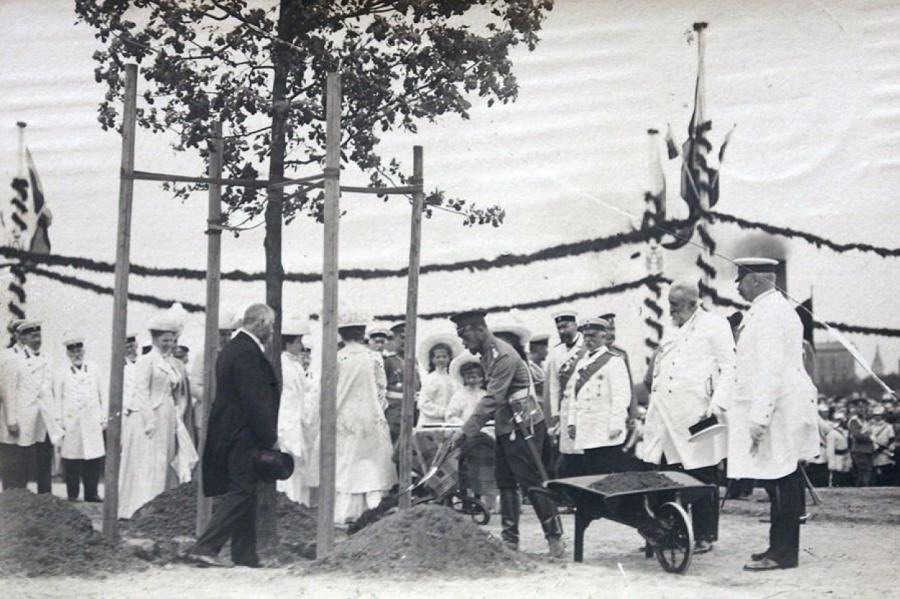
The official opening ceremony of the park complex took place on July 5, 1910, coinciding with the visit to Riga of Emperor Nicholas II, who arrived with his family on the imperial yacht "Standart" to celebrate the anniversary of Livonia's accession to Russia. The ceremony was attended by Chairman of the Council of Ministers Pyotr Arkadyevich Stolypin and Minister of the Imperial Court Baron Frederiks.
The Tsar and his entourage arrived on a steam boat, which docked at the Agenskalns pier, where they were awaited by the Mayor of Riga George Armitstead, the head of the Riga police department State Councillor Nilenner, and representatives of the Livonian nobility.
The Tsar walked to the tree planting site, where he was ceremoniously presented with a leather folder containing the plan for the future park. Nicholas II planted a 20-year-old oak sapling, while his daughters, Grand Duchesses Olga, Maria, and Anastasia, planted 12-15-year-old saplings. Princess Anastasia ran up to Georg Kufaldt asking to water the trees when the Tsar and his family would return to St. Petersburg. The Empress, in memory of the event, presented the chief gardener with a gold watch featuring the emblem of the imperial eagle, adorned with diamonds...
The Same Soup, Just a Thinner Broth
Recently, your author had the opportunity to participate in a meeting of the City Council's Culture Commission, chaired by Davis Stalts (National Alliance). The deputies and invited officials outlined a concept – to celebrate Lāčplēsis Day on November 11 in Victory Park. For it was in honor of that victory in 1919 that the park was named during the First Republic.
There, various military-patriotic events took place, and during the time of Kārlis Ulmanis, in 1936, a law was passed for the construction of Victory Square. In 1937, a project competition was announced, to which 44 proposals were submitted. The plans were grand: to create a square for 200,000 visitors, a stadium for 25,000 spectators, sports grounds, a velodrome, a swimming pool, a shooting range, a port in the Agenskalns Bay, a Palace of Sports and Meetings for 10,000 people, as well as a monument that would mark the architectural dominance of the entire complex.
Now, as they say – the same soup, just a thinner broth. On the national holiday – a stage will be set up in the middle of Barinju Street, leading towards the Agenskalns market. The public will be offered a musical and poetic performance under the auspices of the 125th anniversary of the outstanding poet Alexander Čaks, who in 1917, on the wave of Latvian rifle battalions, published the first patriotic poem "Jel celies, Latvija, tu svētā". Later, however, he lived in the RSFSR and even worked as an editor for the newspaper "Path of Communism" in the very Saransk, where Gérard Depardieu later received housing.
The famous composer Jānis Lūsēns has been chosen as responsible for the artistic component of the celebrations on November 11. Raimonds Pauls was also suggested – he declined. The holiday budget includes fees for artists – 130,000 euros. Part of the funds is expected to be recouped through food vendors, who will pay the city 2,000 euros each.
Participants in the meeting were somewhat puzzled when the topic of potential drone threats arose. It is possible that in the event of an "orange" alert, the celebration will have to be interrupted! Therefore, the Cabinet of Ministers should have taken financial measures in advance to insure against such force majeure situations.
But for now, Uzvaras Park is worth visiting, without any over-organization and pomp, simply as a place for relaxation.




Leave a comment