
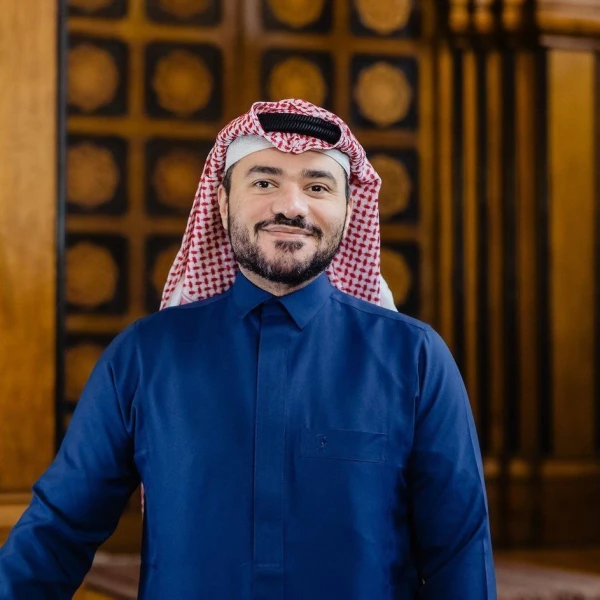
This week, Riga was visited by a prominent public figure from the United Arab Emirates, Loay Alshareef — an Arab activist, historian (well-versed in Egyptian hieroglyphs and ancient Arabic scripts), and influencer with over 800,000 followers on X and Instagram worldwide.
He is convinced that peaceful coexistence between people with different views, cultural codes, and religious beliefs is both possible and necessary.
In Riga, Mr. Alshareef met with leading politicians, diplomats, and journalists. Among the latter was a representative of bb.lv.
- You are a regular participant in international conferences and university discussions around the world. What is your goal, what would you like to achieve?
— To be clear from the start: I was born in Saudi Arabia, in a very conservative Muslim family. In both my family and school, I saw one thing — hatred towards Jews, towards Israel. But later, while studying in France, I found myself in a Jewish family. No one imposed their views or narratives on me there: I just lived, observed, perceived, and evaluated. I understood that if people are raised in hatred, it will not end well.
Everything I have come to — I came to on my own. And I want the world to hear my voice, as well as the voice of those Arabs who truly want peace and prosperity. Those who believe that people of different religions, including the three Abrahamic ones — Christianity, Islam, and Judaism — can and should live in peace. My travels across Europe, including Latvia, are a kind of visit of hope. I want the world to hear: not all Muslims are enemies of Christians, Israel, and Jews. Conveying this to the world is what I consider my mission.
— In that case, what is your “Arab perspective” on the events that are currently attracting global attention? Unlike European countries, there have been no pro-Palestinian demonstrations in Arab countries. Moreover, none of Israel's neighbors (Egypt, Jordan) allowed civilians from Gaza even for a short time during military actions. How can this be explained?
— Europeans, especially the youth, approach what is happening in our region emotionally, without caring about the facts, and most draw unverified information, primarily from social media. Arab countries are much closer to the epicenter of events, so they assess the situation rationally and are guided by facts. In our region, people still remember “Black September” in the 1970s when PLO militants led by Yasser Arafat attempted to violently overthrow the legitimate government of Jordan that had sheltered them. Everyone knows how much grief Hezbollah militants brought to Lebanon. Therefore, with all sympathy, neighbors prefer to distance themselves from the radicals, whom they obviously consider the majority of Gaza's residents.
I want to clarify right away: I sympathize with people suffering from war, and in this sense, I am pro-Palestinian. But, understanding and realizing the root cause of this suffering, I am against Hamas and other terrorist groups. And those Europeans who today march with Palestinian flags, chant “From the river to the sea” and “free-free Palestine” and instigate riots — they are indeed supporting the forces that bring death, destruction, and chaos. It is sincerely sad when decent but misled people join the ranks of demonstrators, who do not even realize that they are blind instruments of the radicals.
— Today, thousands of people are dying from hunger and disease — for example, in Sudan and Yemen. The nearly 50 million Kurdish people have been fighting for their state for decades but do not have it. The list of disasters in different parts of the world can go on and on. But the focus of the UN and other international organizations, as well as the public and leaders of Europe, Canada, Australia, etc., is precisely on tiny Gaza. Why do you think this is?
— This question is very deep and multifaceted, and it is practically impossible to illuminate it within the framework of a small interview. Therefore, I will answer briefly: the speeches “for Gaza” are actually speeches against Israel. If Israel were involved in any other conflict, these people and organizations would still be advocating for the other side of the conflict. There is even a joke: “No Jews - no news.” And the reason why this is so is indeed a topic for deep analysis. Each person has their own, sometimes profound reasons for this. Some find it incomprehensible and unpleasant that this is the only democracy in the Middle East, a thriving state created literally on sand and swamps, capable of defending itself, its independence among a rather hostile environment. In some, generations of animosity towards Jews have suddenly found a way to be expressed in this manner. Some sincerely believe that Israel's actions are unlawful and too harsh. There are many reasons.
What cannot be disagreed with is that the attention to Gaza from the UN and other international organizations is indeed hypertrophied, especially compared to how unacceptably little attention they pay to the suffering of residents in other countries, where the number of those suffering far exceeds the population of Gaza, and the level of suffering is no less.
— Many pro-Palestinian demonstrations in EU countries look very similar: faces wrapped in scarves, aggression, riots, clashes with the police — as if following a single script. In response, another radical “wave” rises, calling to expel all “foreigners” from their countries. How do you think we can contain the development of radicalism both “from the left” and “from the right”? And also: during your time in Latvia, you had the opportunity to communicate with various people; did you feel anything in your conversations that raised concerns?
— Unfortunately, in many EU countries, a significant number of radicals have arrived due to uncontrolled immigration, whose agitation has fallen on fertile ground. Now, to bring life back to normal, the leadership of these countries will require considerable effort.
As for Latvia — a country with a very small population — it is relatively easy to control the situation here and, if necessary, take timely measures. Nevertheless, it is still necessary to constantly monitor the situation, thoroughly check everyone who enters the country and stays — whether temporarily or permanently. Regardless of nationality and religion, as radicalism is a matter that is by no means limited to nationality and/or faith. It is an evil that is non-confessional and international.













Leave a comment