
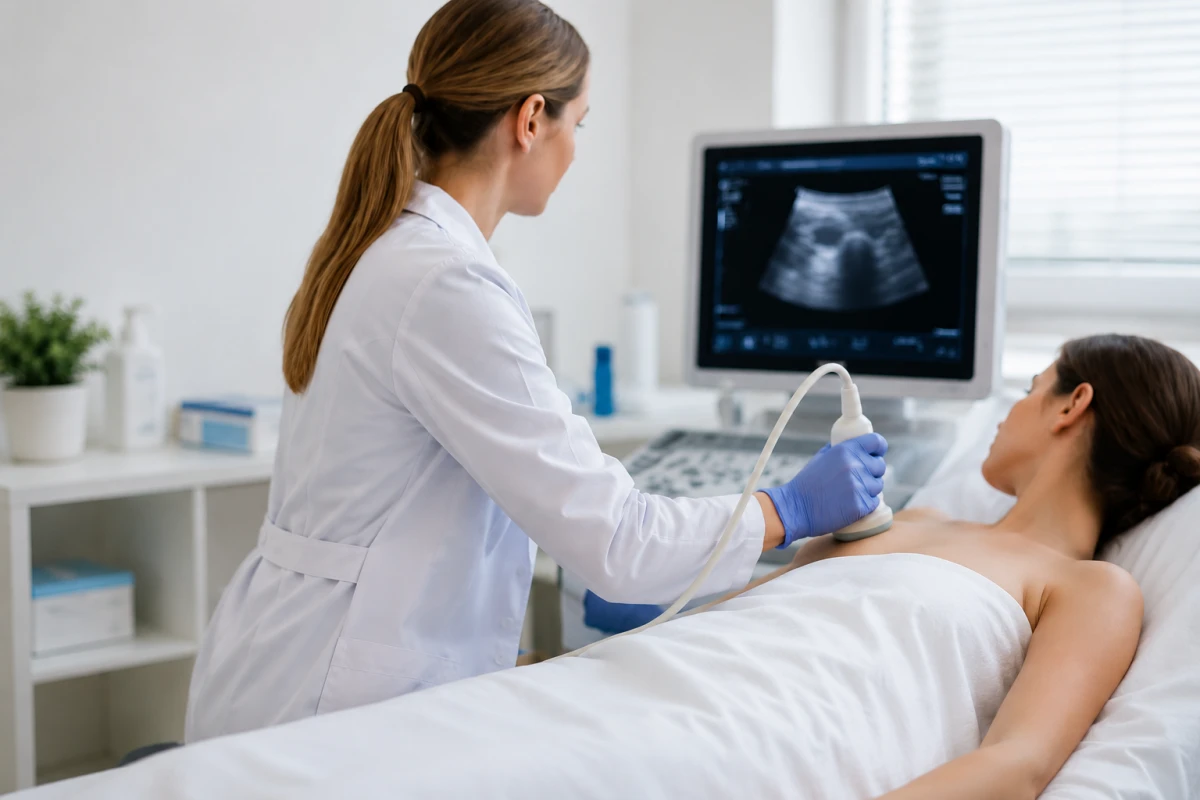
Upon discovering a lump in the breast, many women begin to worry. Any neoplasm is often associated with oncology, so even after a doctor's words about a benign process, the question remains: how safe is it and is there a risk of cancer in the future?
Together with oncologist mammologist and gynecologist Anastasia Klimova, we explore what fibroadenoma is and when it requires special attention.
What is Fibroadenoma
"Fibroadenoma of the breast is a benign nodular formation consisting of glandular and connective tissue. It usually has clear boundaries, a rounded shape, and a dense but elastic structure. Upon palpation, such a nodule is easily movable and not connected to the surrounding tissues," explains Anastasia Klimova.
The size of the formation can vary from a few millimeters to several centimeters. Sometimes fibroadenoma remains unchanged for years, while at other times it gradually increases. Nodules can be solitary or multiple, occurring in one or both breasts.
Fibroadenomas are most often detected in women of reproductive age, but they can also appear in adolescents and older women.
Why Does Fibroadenoma Occur
The exact cause of fibroadenoma development is still unknown. Specialists associate their development with hormonal changes, primarily with the balance of estrogens and progesterone.
"Estrogens stimulate the growth of glandular tissue, while progesterone limits this process. If the balance is disrupted, nodular changes may form," notes the expert.
Therefore, fibroadenoma can increase during pregnancy, respond to hormonal fluctuations throughout the cycle, and become less noticeable after menopause.
It is important to remember: a cyst and a fibroadenoma are different formations. A cyst is a cavity filled with fluid, while a fibroadenoma is a dense fibrous-glandular nodule.
How Does Fibroadenoma Manifest
Most often, fibroadenoma does not manifest itself. Many women find out about it accidentally during self-examination or routine ultrasound.
Sometimes breast tenderness may occur before menstruation; however, this is related to hormonal changes and is not considered a specific sign of fibroadenoma.
"A reason to see a doctor is any change in the usual pattern: breast deformation, nipple retraction, discharge, especially bloody, as well as the appearance of new lumps," emphasizes the mammologist.
Can Fibroadenoma Turn into Cancer
In most cases — no. A typical fibroadenoma is not considered a precancerous condition and does not serve as a source for the development of breast cancer.
"The exception is rare phyllodes (leaf-like) tumors. They differ in structure and behavior, can grow rapidly, and in some cases have malignant potential," explains Anastasia Klimova.
Therefore, not only the presence of a nodule matters, but also its type, size, growth dynamics, and examination results.
When Is Closer Monitoring Required
Special attention is needed in cases of:
- rapid increase in the formation;
- heterogeneous structure according to ultrasound or mammography;
- detection of atypical cells during biopsy;
- family history of breast or ovarian cancer;
- appearance of a new formation at an older age.
In such cases, the doctor may recommend additional examinations or more frequent monitoring.
When Is Removal Required
"Surgery is not always necessary. Indications may include nodule growth, discomfort, breast deformation, or questionable diagnostic results," says the specialist.
Sometimes removal is performed to clarify the diagnosis if the examination results do not allow for the complete exclusion of another nature of the formation. If there is suspicion of a phyllodes tumor, surgery is also considered the preferred option.
After removal, the tissue is always sent for histological examination.
How to Monitor the Condition
It is impossible to prevent the appearance of fibroadenoma, but it can be detected and monitored in a timely manner.
To do this, it is recommended to:
- regularly visit a mammologist;
- undergo ultrasound or mammography as prescribed by a doctor;
- pay close attention to any changes in the breast;
- consider hereditary predisposition.
"Self-examination once a month helps to notice new lumps, but it does not replace instrumental diagnostics," reminds the expert.
Fibroadenoma of the breast is a benign formation that, in most cases, is not associated with the development of cancer. Most often, it remains stable and does not pose a threat to health. However, any neoplasm in the breast requires examination and regular monitoring to timely notice possible changes and maintain confidence in one's health.












Leave a comment