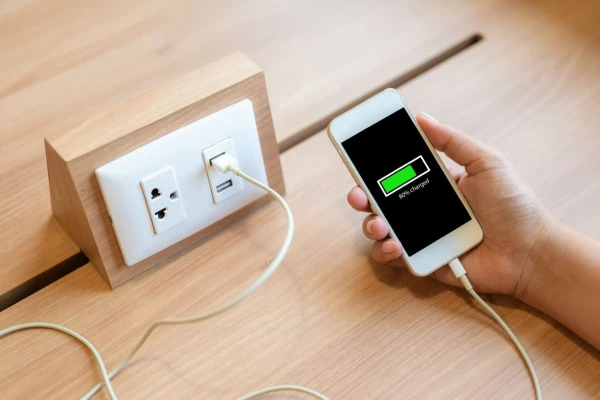
There are many recommendations surrounding smartphone charging, among which the so-called '20–80' rule holds a special place. It suggests that to extend battery life, the device should not be discharged to zero and not charged to 100%. But how justified is this recommendation in practice — a question that requires more detailed consideration.
What Happens Inside the Battery
Modern smartphones are equipped with lithium-ion batteries, the operation of which is associated with gradual chemical changes. Each charging and discharging cycle is accompanied by natural wear: reactions occur inside the battery that reduce its capacity over time.
The greatest stress occurs in extreme states — when almost fully charged and deeply discharged. In these modes, processes that affect battery longevity accelerate, causing it to lose its ability to hold a charge more quickly.
Why Depth of Discharge Matters
The lifespan of a battery is commonly measured by the number of cycles. However, not only their volume is important, but also the depth of discharge.
When regularly operating in the range from nearly full charge to zero, the battery wears out faster. In a more "gentle" mode, where the charge fluctuates in the mid-range, wear occurs more slowly, allowing for an increase in the overall lifespan of the device.
What Manufacturers Do
Smartphone manufacturers take these features into account and implement software mechanisms to protect the battery. Many devices can slow down charging after reaching a certain level and bring it to 100% only by the time the user typically disconnects the phone from the power source.
Such functions help reduce the load on the battery without the need for constant user monitoring.
The Main Factor — Not Just Percentages
Despite the popularity of the '20–80' rule, the key factor affecting battery wear remains temperature. Overheating significantly accelerates battery degradation.
Using a smartphone while charging, keeping the device in the sun, or in poorly ventilated places can cause more harm than rarely charging it to 100%.
Myth or Useful Habit
The claim that you "shouldn't" charge your phone to 100% is an exaggeration. Modern devices are protected from overcharging, and the negative effect manifests only as accelerated but gradual wear.
The '20–80' rule can be seen as a recommendation for those who want to maximize their battery's lifespan. However, in everyday life, it is acceptable to deviate from it, especially when a full charge is required — for example, before a trip.
What’s the Bottom Line
The optimal approach to charging is a balance between convenience and careful use of the device.
Maintaining a moderate charge range can indeed slow down battery wear, but it is not a strict requirement.
It is much more important to avoid overheating and extreme operating conditions, which affect the battery more than the numbers on the screen.