
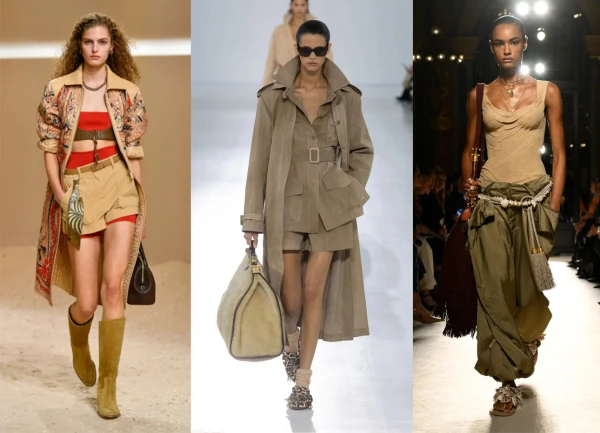
The safari trend has once again come to the forefront of designers' attention, but in a new interpretation—more restrained and adapted for everyday life. Fashion experts explain how to incorporate the characteristic elements of this style into an urban wardrobe without turning the look into a "vacation outfit."
The safari style is historically associated with travel and expedition clothing: comfortable, functional, and grounded in a natural palette. However, in modern collections, it has lost its literal meaning and become a universal direction that easily integrates into everyday fashion. Designers suggest not to copy looks "from the jungle," but to use individual elements to create more concise and appropriate combinations.
The color palette plays a key role. Traditional safari shades—beige, sandy, khaki, olive, and brown—remain relevant this season. They pair well with each other and serve as an excellent base for layered looks. At the same time, stylists recommend mixing them with fresher accents—such as white, cream, or muted pastel tones—to make the outfit look lighter and more modern.
One of the most recognizable elements remains shirts with patch pockets. In the current interpretation, they can be either fitted or loose-fitting. They are worn not only as standalone tops but also as light jackets—over a tank top, blouse, or dress. Such items easily combine with jeans, classic trousers, or skirts, allowing for the creation of versatile city outfits.
Safari-style dresses also continue to be popular. Typically, these are models with a belt that shapes the silhouette and functional details—pockets, buttons, and a turn-down collar. They look sufficiently restrained to fit into an office wardrobe while remaining comfortable for everyday wear. Depending on the shoes and accessories, such dresses can be adapted for various situations—from business meetings to casual walks.
Cargo pants and shorts with utilitarian elements also remain relevant. However, their design is becoming more minimalist: the number of decorative details is decreasing, and the cut is becoming neater. This makes such items more versatile and allows them to be paired not only with basic t-shirts but also with blazers, shirts, or even more formal wardrobe elements.
Particular attention should be paid to fabrics. Safari style is traditionally characterized by natural materials—cotton, linen, and sturdy twill. They provide comfort and practicality, which is especially important in the spring-summer period. Modern brands also use blended fabrics that hold their shape better and simplify garment care.
Accessories play an important role in shaping the look. Belts, crossbody bags, minimalist backpacks, and comfortable footwear—sandals, loafers, or sneakers—help emphasize the utilitarian nature of the style. At the same time, stylists recommend avoiding excessive theatricality: safari-style hats or an abundance of thematic details can make the outfit too costume-like.
The main principle that experts insist on is moderation. It is enough to include one or two characteristic elements in the outfit to create a relevant silhouette. Complete copying of the safari style can look outdated and inappropriate in an urban environment.
...The modern interpretation of safari is a balance between functionality and aesthetics. The trend adapts to the rhythm of the city, maintaining practicality and comfort while shedding excessive straightforwardness. Thanks to a universal palette, comfortable silhouettes, and thoughtful details, the safari style becomes part of the basic wardrobe rather than just a vacation story.










Leave a comment