
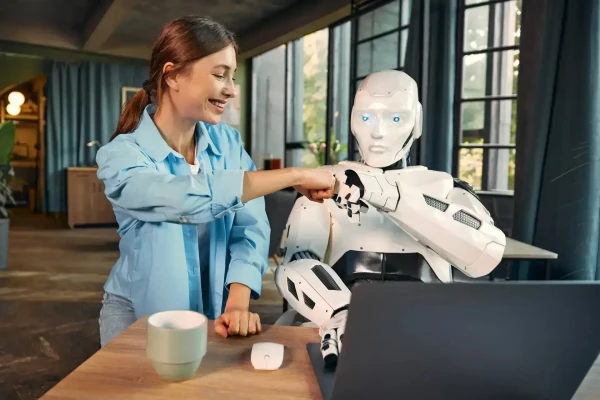
Artificial intelligence is increasingly penetrating the field of mental health. Online bots, applications, and digital assistants are already helping people cope with stress, anxiety, and uncertainty. But how effective are they — and can they replace a live specialist?
How AI is Useful in Therapy
One of the main advantages of AI is its ability to help a person better understand themselves. In a dialogue with a digital assistant, we formulate thoughts, answer questions, and structure experiences — thereby clarifying our internal states.
AI acts as a neutral "mirror":
-
it does not judge or criticize,
-
it does not interrupt or get lost in its own emotions,
-
it helps to see contradictions and clarify thoughts.
Such a process can be therapeutic in itself: sometimes it is important not to receive advice, but to hear oneself.
Another plus is accessibility.
You can talk to the bot at any time, without appointments or waiting. It does not get tired, does not judge, and does not create psychological pressure.
Many digital tools can:
-
recognize anxious thoughts,
-
suggest basic self-help techniques,
-
utilize elements of cognitive-behavioral therapy.
Where the Limits of Possibilities Lie
Despite the advantages, AI has fundamental limitations.
It:
-
does not feel emotions,
-
does not pick up on non-verbal signals,
-
does not understand the deep context of a person's life.
AI does not "hear" pauses, does not notice intonations, and cannot truly empathize.
Therefore, it can be useful in cases of:
-
mild anxiety,
-
stress,
-
fatigue,
-
the need to vent.
But in situations related to:
-
depression,
-
trauma,
-
suicidal thoughts,
-
complex relationships
— the help of a live specialist remains irreplaceable.
Will AI Replace Psychotherapists?
Most likely, no. AI is already capable of taking on some tasks — for example, monitoring conditions or assisting in self-analysis. But the key value of therapy lies in human contact.
Empathy, intuition, and live presence are things that cannot be algorithmized.
In the future, the role of the psychotherapist will likely become even more significant: specialists will work where technology is powerless.
Ethical and Legal Risks
The development of technology is outpacing regulation. This raises a number of questions:
-
how are users' personal data protected,
-
how accurate are AI recommendations,
-
who is responsible for possible mistakes.
The problem of critical situations is particularly acute: if a bot fails to recognize a dangerous state or gives incorrect advice — the consequences can be serious.
How to Use AI Beneficially
The optimal approach is not to oppose technology and live therapy, but to combine them.
AI can be useful as a tool:
-
for keeping a "thought diary",
-
for practicing mindfulness,
-
as support between sessions with a psychologist.
But it is important not to shift the responsibility for one's state onto it.
Can You Trust AI with Your Problems?
The question of trust here is ambiguous.
On one hand, AI:
-
does not judge,
-
helps to structure thoughts,
-
creates a safe space for openness.
On the other hand, it:
-
does not feel,
-
does not understand the depth of personal experience,
-
does not bear responsibility for the consequences.
Therefore, the best option is to use it as an auxiliary tool, but not as a replacement for live communication.
Artificial intelligence has already become a part of psychotherapy — and is likely to remain so. It can support, help to understand oneself, and reduce anxiety. But it cannot replace a live person.
True understanding still arises only in contact between people.















Leave a comment