
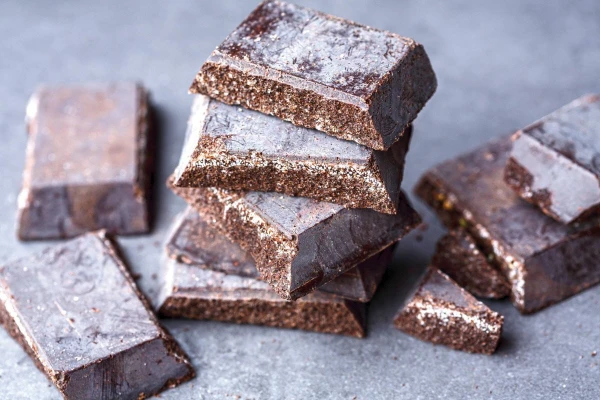
Whitish spots on chocolate often raise doubts: has the product spoiled or is this a normal occurrence? In fact, such a coating does not always indicate that the chocolate is unsafe. Let's clarify what it means and when to be cautious.
Why Does Chocolate Develop a White Coating
Chocolate can appear in various colors — from light brown to almost black, as well as white and ruby. However, sometimes a light coating appears on its surface, resembling mold.
In most cases, this is not spoilage but a result of changes in storage conditions — temperature or humidity.
There are two main types of such coatings:
-
Sugar Bloom — occurs when in contact with moisture. Sugar dissolves and then crystallizes on the surface, forming a whitish layer.
-
Fat Bloom — appears due to temperature fluctuations. The fats in the chocolate melt and then solidify, creating light streaks.
This phenomenon is referred to as "blooming" of chocolate. It affects the appearance but does not make the product unsafe.
Is It Safe to Eat Such Chocolate?
If chocolate has developed a white coating, but:
-
there is no unpleasant odor,
-
there is no fluffy or uneven texture,
-
the product has not been exposed to moisture and is not covered in mold,
— it can be safely eaten.
Such chocolate may look less appetizing, but its taste and nutritional value are generally preserved.
When Is Chocolate Really Spoiled?
There are cases when it is better to throw the product away:
-
a musty or rancid smell has developed,
-
mold is visible (fluffy texture, spots of different colors),
-
insects or larvae are found inside,
-
the chocolate has been exposed to excessive moisture.
In these situations, the product is indeed spoiled.
How to Properly Store Chocolate
To avoid the development of a coating and preserve flavor, it is important to follow storage conditions:
-
keep chocolate in a dry and cool place,
-
avoid sunlight and high temperatures,
-
do not store it in the refrigerator — temperature fluctuations can degrade quality,
-
store the product airtight to prevent it from absorbing foreign odors.
White chocolate is particularly sensitive to storage conditions, while dark chocolate is more resilient.
A white coating on chocolate is most often not a sign of spoilage but a result of improper storage. Such a product can be eaten if it has no unpleasant odor and signs of mold.
The key is to distinguish harmless "blooming" from actual spoilage.















Leave a comment