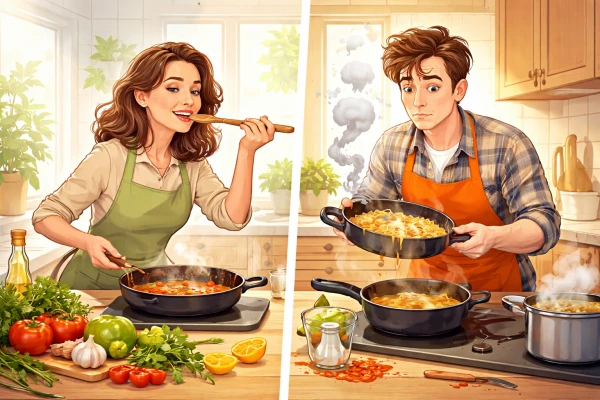
Many have noticed: two people can cook the same dish from the same recipe — and the result can be completely different. One person's dish is aromatic and tasty, while the other’s seems correct, but something is missing. The issue here is not just about "talent." Several factors influence taste — and many of them are much more important than they seem.
Experience and "Honed Skills"
The first and most obvious factor is practice.
A person who cooks often begins to sense the ingredients:
- when to lower the heat
- how much salt to add
- when the dish is ready
This cannot always be precisely outlined in a recipe. Over time, intuition develops, and it is this intuition that makes food tastier.
Attention to Detail
Cooking is not just a list of steps, but also the little things:
- temperature
- time
- quality of ingredients
- sequence of actions
Beginners often overlook these nuances: they may get distracted, overcook the dish, or, conversely, undercook it. As a result, the taste suffers, even if the recipe is followed.
Mood and Engagement
This may not sound very scientific, but it works in practice.
When a person cooks calmly, with interest and attention, they:
- do not rush
- monitor the process
- handle the ingredients carefully
If cooking is done "on the go" or in a bad mood, mistakes are more likely to occur — over-salting, burnt bottoms, or incorrect proportions.
Ability to Sense Flavor Balance
A good cook always balances flavors:
- salt
- sweetness
- acidity
- fattiness
This is what distinguishes merely "edible" dishes from truly delicious ones. And this skill is also learned over time.
Following the Recipe
For beginners, a recipe is the foundation.
Changing proportions a little "by eye" can lead to disappointing results. This is especially important in baking, where precision plays a key role.
Experienced cooks can experiment, but first, it is important to learn to cook by the rules.
Individual Strengths
Everyone has dishes that they make best. Some people excel at salads, others at meat, and some at baking.
This is normal: there are not many universal cooks, and almost everyone has their own "signature" dishes.
The Main Point
The taste of food is not magic or "special energy," but a combination of experience, attention, and attitude towards the process.
The good news is that this can be learned. The more practice and interest in cooking, the tastier the dishes become — and over time, the difference between "not tasty" and "very tasty" simply disappears.