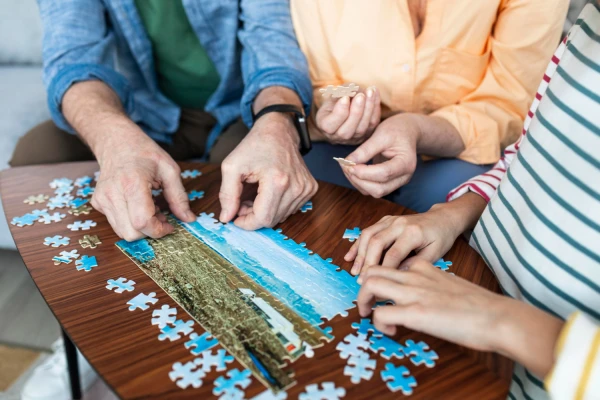
Puzzles are often considered a children's pastime. But they are also beneficial for adults—they are a real workout for the brain. The neurologist recommends assembling pictures from many small pieces. Here are a few more tips.
Puzzles are an effective exercise for human cognitive abilities. By constantly envisioning the completed picture and finding a place for each piece, one can not only strengthen existing connections between brain cells but also create new ones. This contributes to increased thinking speed and the development of short-term memory, says neurologist Yulia Varlamova.
Boosts the Brain
Such puzzles help improve problem-solving skills:
-
they teach forecasting,
-
they test different solution options,
-
they develop personal action strategies.
Each hemisphere of the brain is responsible for certain processes. The left represents the end result, while the right seeks ways to achieve it. Regularly assembling puzzles promotes the development of both hemispheres, significantly enhancing brain productivity,” notes the neurologist.
Dopamine from the Box
Creating a picture from many pieces contributes to the production of dopamine as a result of satisfaction from one’s work.
“The larger and more detailed the puzzles, the more beneficial they are. The effectiveness increases with regular assembly. That’s why, after completing a complex puzzle, a person experiences pleasure. This activity contributes to psychological balance and a good mood. After a hard day’s work, such a puzzle helps relieve tension,” explains Yulia Varlamova.
For the Elderly
It has been proven that regular activities requiring mental effort reduce the risk of memory problems in old age. Puzzles are a beneficial form of leisure for elderly people. They promote the development of fine motor skills, which serves as a prevention of dementia (reducing the risk of its development by 50%). Additionally, assembling puzzles lowers stress levels by decreasing cortisol levels and also trains patience, reducing manifestations of ADHD.
Looking at the final picture depicted on the box, a person develops skills such as analysis, comparison, and classification.
Tips for Assembling Puzzles
-
When assembling a picture from hundreds of pieces, everyone chooses a convenient strategy.
-
It is most effective to start with the frame. This will provide clear boundaries for the image and help visualize the proportions of the objects.
-
It is convenient to sort pieces by colors or fragments. Separate trays can be used for this purpose.
-
To avoid losing focus, it is better to mentally divide the puzzle into zones and assemble each part in turn.
-
To make it easier to find small fragments, a magnifying glass can be used.
-
It is important to prepare a comfortable place with good lighting. If the puzzle consists of a large number of pieces, it may take considerable time to assemble.
-
Every 30 minutes, one should get up to stretch. If fatigue sets in, it is better to take a break and switch to another activity. After all, besides benefiting the brain, puzzles should also bring pleasure.
Complicate the Task
A great workout for spatial thinking and imagination is to complicate the task and not use the reference picture while assembling the puzzle. This significantly develops the ability to forecast, believes the neurologist.
There is an even more challenging option—unusual puzzles for adults with a "backward" concept. The initial picture depicts the plot's setup (for example, the characters are looking at something), and what needs to be assembled is what they are actually looking at. There are similar puzzles where one has to piece together a scenario that will occur after the depicted one, or how the characters will look 30 years later in the same company.