
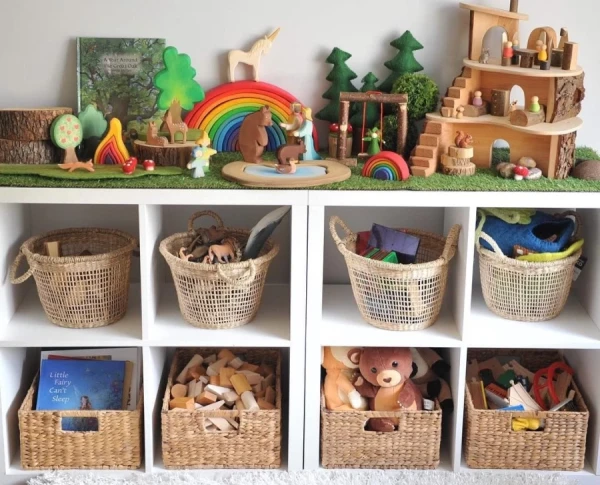
Maintaining order in a child's room is not only an aesthetic task but also a functional one. When toys are organized thoughtfully, it is easier for the child to play and clean up after themselves, while you free up space and time from constant mess.
1. Create an Accessible System
The main rule is that everything the child uses regularly should be within reach at their height. High shelves and deep cabinets create unnecessary obstacles: the child will have to stretch or ask for help, which means order will not be maintained.
2. Use a Variety of Storage Solutions
Modern ideas for organizing a child's room are based on a combination of several types of storage:
-
Open baskets and containers — easy access to toys and a clear view of the contents.
-
Under-bed drawers or shelves — allow for effective use of every corner of the room.
-
Multifunctional furniture (with storage spaces inside) — combines play, sleep, and organizational functions.
-
Modules with cube shelves — allow toys to be categorized: building sets, soft toys, figures, etc.
3. Categorize by Type
Grouping toys by type helps the child navigate and return each item to its place more quickly. For example, building sets, puzzles, and soft toys can be stored in separate baskets or boxes.
4. Pay Attention to Safety
When choosing storage systems, consider safety: sturdy fastenings for high shelves, absence of sharp corners, and stability of furniture. High shelves should be securely fixed to avoid tipping.
5. Involve the Child in Cleaning
To maintain order, it is helpful to teach the child to clean up toys after playing. Bright baskets with pictures or color labels on containers help children navigate the system faster and learn responsibility.
6. Maintain a Rotation Strategy
If a pile of toys accumulates quickly, you can use a rotation strategy: temporarily store some toys away and periodically change the available sets to keep the interest in play and reduce clutter.














Leave a comment