
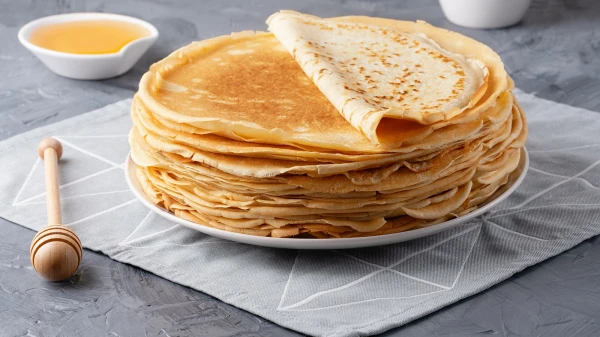
The dream of thin, lacy pancakes with bubbles often does not match the result: they tear, come out dense or rubbery. The reason lies not in the recipe, but in typical mistakes.
The first problem is related to a cold pan and incorrect heating. A thin pancake requires instant searing, and with weak heat, the batter spreads into a thick cake. The best option is a heavy skillet with a thick bottom, well-heated, almost to the point of smoking, over medium or slightly above medium heat.
The second mistake is the refusal to use oil. It is the hot oil under the liquid batter that creates air bubbles, forming a lace-like structure. Without it, the pancake may turn out thin but will remain smooth. A few drops of oil, evenly distributed across the bottom of the pan, are sufficient.
The third reason for failures is the imbalance of flour and eggs. An excess of flour makes the pancake dry and thick, while too many eggs make it heavy and rubbery. The batter should be fluid, resembling liquid sour cream, and easily flow off a spoon, with the amount of liquid adjusted gradually. Three to four eggs are enough for one liter of liquid.
The fourth mistake lies in the excess sugar. It is responsible for browning, but when the norm is exceeded, the surface of the pancake quickly caramelizes, becoming dense and rough. A moderate amount of sugar allows for maintaining thinness.
The fifth problem is related to the prolonged “resting” of the batter. For regular pancake batter made with milk or kefir, a long pause leads to excessive elasticity and poor spreading. A short break of 15 minutes is enough for the flour to swell and the structure to become even.















Leave a comment