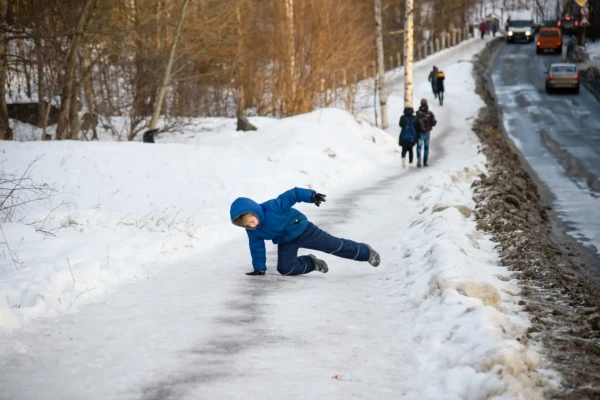
Winter increases the risk of injuries: bruises, sprains, dislocations, and fractures. The greatest danger is posed by children actively moving outdoors and elderly people, whose balance deteriorates with age.
"The most common winter injuries are bruises and sprains from falls on slippery surfaces. Among more serious injuries are fractures of the radius from falling on an outstretched hand, ankle fractures from twisting the foot, and hip fractures, which are especially dangerous for the elderly: they can lead to disability or death," warns Olga Malinovskaya, a physician in clinical laboratory diagnostics.
How to Recognize an Injury
After a fall, the consequences may not be obvious. The main symptoms include:
- sharp pain at the site of impact;
- hematoma and swelling;
- limited mobility of the limb;
- pathological mobility in atypical areas (characteristic of a fracture).
Even if the injury seems minor, do not immediately try to "walk it off," massage, or rub the impact area — this may worsen the damage.
First Actions After a Fall
- Ensure immobility of the injured limb.
- Apply a cold compress to reduce pain and swelling.
- Consult a doctor for examination and testing (X-ray, CT scan).
Even a minor injury can turn out to be a sprain, ligament tear, or fracture.
Particular attention should be paid to head injuries. When falling and hitting the ice or a hard surface, there may be damage to the skull and brain. In such cases, a doctor may prescribe a CT scan to rule out serious complications.
When Additional Investigations Are Needed
If there is severe swelling, pain, or fever, this may be a sign of osteomyelitis — an infectious complication of fractures. The doctor may order:
- a complete blood count;
- a test for C-reactive protein.
Prevention of Winter Injuries
- Choose footwear with non-slip soles.
- Avoid sudden and rapid movements on ice.
- Move cautiously, maintaining balance.
Adhering to these rules will help reduce the risk of injuries and avoid serious complications in winter.