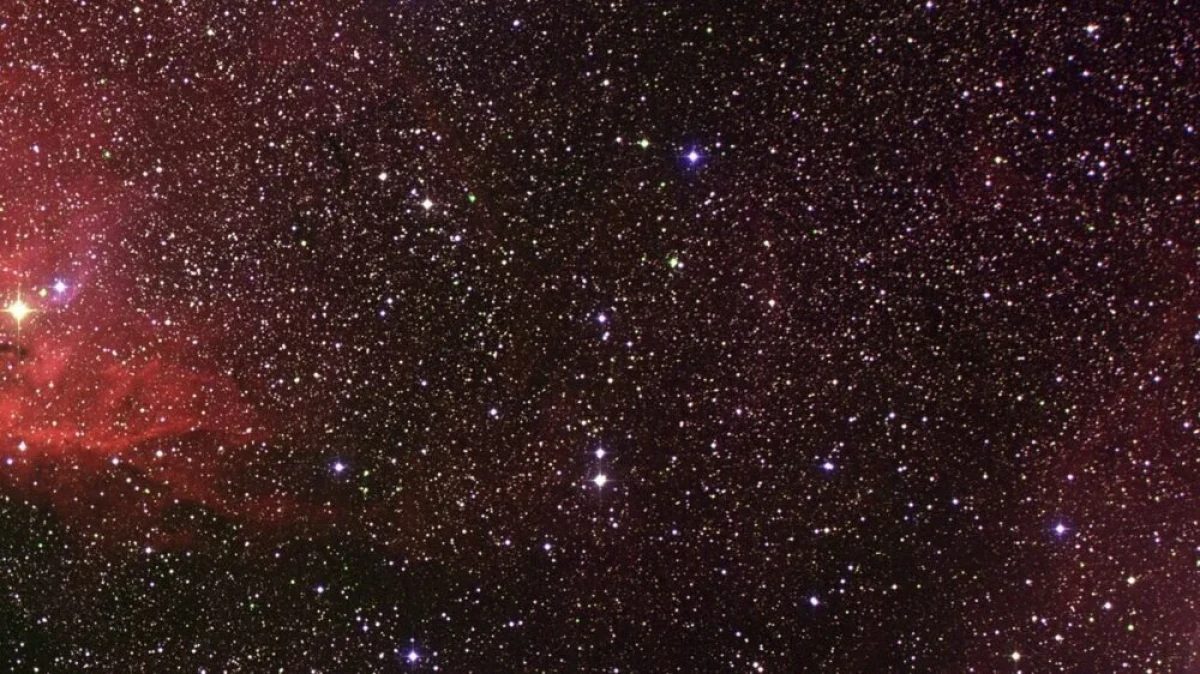
During observations, a "Little Red Dot" accidentally entered the telescope's field of view.
A group of American astronomers led by Vasily Kokorev from the University of Texas has obtained new data confirming one of the leading hypotheses about the nature of the so-called "Little Red Dots," discovered by the James Webb Space Telescope in 2022. Spectral analysis showed that these objects are likely supermassive black holes surrounded by a dense shell of partially ionized gas. The study was published in The Astrophysical Journal.
Initially, scientists were studying the galaxy cluster Abell S1063 in search of Population III stars—the first stars formed in the universe. However, during observations, a "Little Red Dot" GLIMPSE-17775 accidentally entered the telescope's field of view, located far behind this cluster.
The successful observation of GLIMPSE-17775 was aided by the so-called gravitational lensing effect—a phenomenon where the trajectory of light from a more distant source is distorted by the gravity of a closer massive object. Thus, the Abell S1063 cluster amplified the light of the distant "red dot" located behind it. Thanks to this, astronomers were able to study GLIMPSE-17775 in detail: gravitational lensing effectively turned 30 hours of observation into 80 hours due to the curvature of spacetime.
The James Webb Space Telescope recorded more than 40 spectral lines emanating from the object. Scientists observed GLIMPSE-17775 as it was approximately 1.8 billion years after the Big Bang. The combination of the telescope's high infrared sensitivity and the natural cosmic "magnifying glass" allowed for the most detailed spectrum of a "Little Red Dot" in the history of studying such objects.
"When we first saw this spectrum, it was like a puzzle with pieces scattered on the floor. We started picking up each fragment, measuring the spectral lines, and putting them together into a single mosaic. At first, some elements seemed meaningless, but then several parts connected, and we realized that we were indeed looking at something important," Kokorev said in a comment to the National Aeronautics and Space Administration (NASA).
Data analysis showed that GLIMPSE-17775 is likely a rapidly growing supermassive black hole hidden within a dense gas cocoon. This cocoon absorbs a significant portion of the radiation emanating from the vicinity of the black hole, forming characteristic features in the observed spectrum.
One of the key signs supporting this model was that the spectral lines of hydrogen, oxygen, and helium did not correspond to a simple picture of a rotating gas cloud. Instead, they matched well with a model that takes into account the effect of electron scattering—broadening of spectral lines due to the interaction of light with electrons. Such an effect is considered a characteristic property of a dense multi-layered gas shell surrounding an extremely powerful source of radiation.
The researchers were also particularly interested in 16 iron lines in the spectrum, which they referred to as the "iron forest." The formation of such a set of lines requires an exceptionally strong source of high-energy radiation, such as a black hole actively accreting matter from outside.
The results explain another feature of the "Little Red Dots." It is known that most of these objects emit weak X-rays. If they are indeed surrounded by dense gas cocoons, then the radiation is simply absorbed by this gas and does not reach the telescopes.
"In the future, I really want to delve deeper into what exactly fuels the central engines of the Little Red Dots. While we currently believe that these are black holes, there are other interesting hypotheses. Perhaps in a year or two, we will finally get a definitive answer to what is truly the source of energy for these objects," Kokorev concluded.