The unusual vehicle can perform various combat tasks.
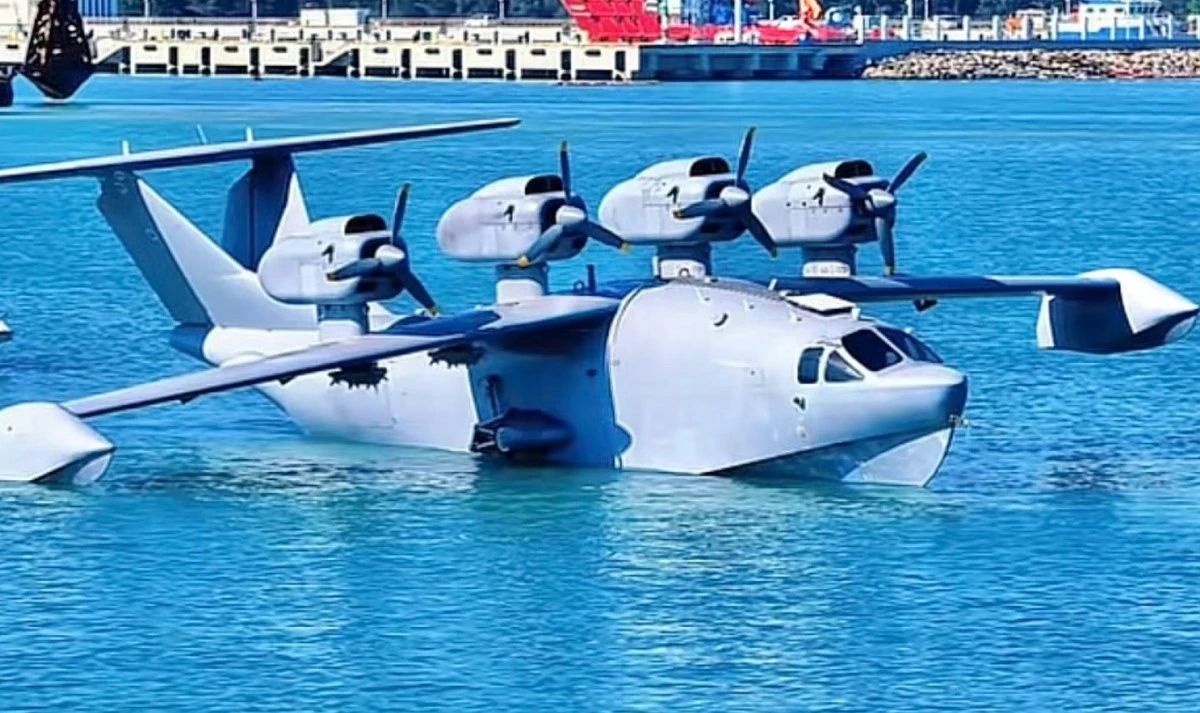
A year ago, a photo of the prototype of a Chinese ekranoplan in the Bohai Sea was published online for the first time, later receiving the unofficial name 'Bohai Monster'. Now new photos have emerged, and judging by the additional suspension points, the ekranoplan may not only transport cargo but also perform combat tasks in the future.
The concept of the ekranoplan originated in the 1930s thanks to Finnish engineer Toivo Kaario. Later, in the 1960s, the technology was developed by German engineer Alexander Lippisch. However, it was only the outstanding Soviet designer Rostislav Alekseyev who managed to bring the concept into 'metal'. In the 1950s and 1960s, under his leadership, a whole series of such vehicles was created, culminating in the legendary 'Caspian Monster' with turbojet engines. Its maximum takeoff weight was an impressive 544 tons, which did not prevent it from reaching speeds of around 500 km/h.
Unlike it, the 'Bohai Monster' is equipped with four turboprop engines, arranged in pairs above the wings. The body design resembles a 'flying boat' with a V-shaped tail. Of particular interest are the pylons under the wings — essentially, suspension points that can be used to carry missiles, bombs, equipment containers, or additional fuel tanks.
According to military experts, the 'Bohai Monster' may be developed with an eye towards possible landing operations in the Taiwan area. The strait, which is about 180 km wide, separating the island from mainland China at one point, could theoretically be crossed by the fast ekranoplan in less than an hour, remaining a more complex target for radars than a conventional airplane, while also bypassing some threats dangerous to landing ships, including sea mines and submarines.