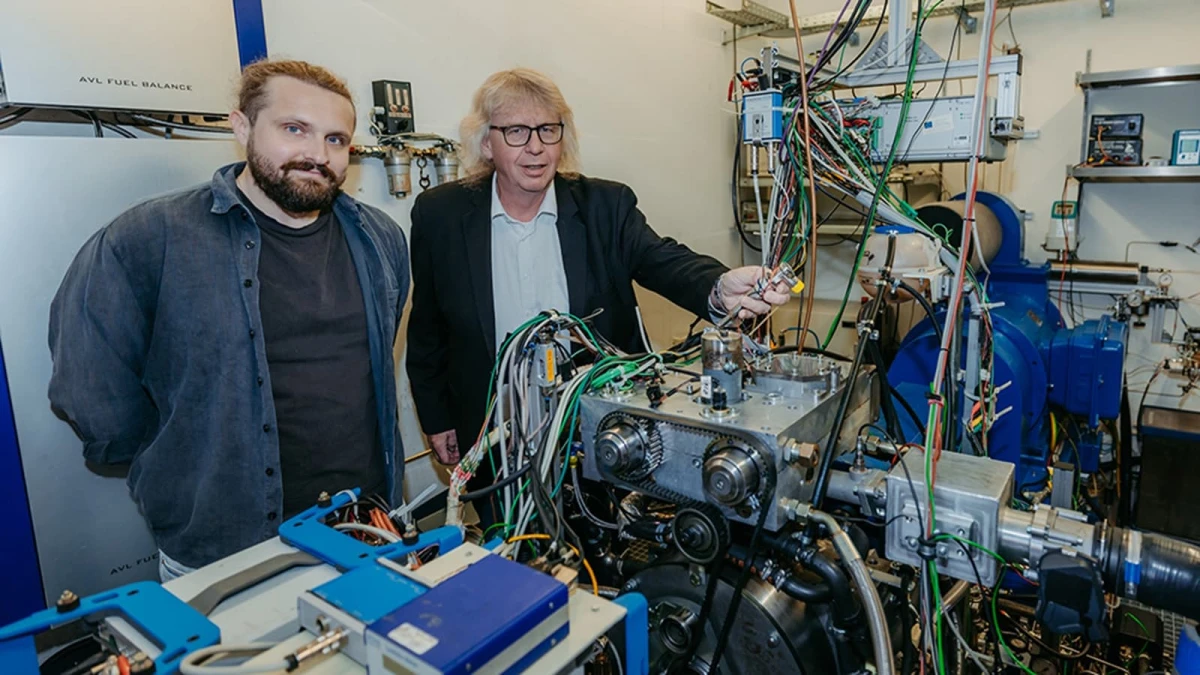
Scientists from the Otto von Guericke University presented an innovative closed-loop engine powered by hydrogen.
Researchers from Germany have developed and demonstrated a closed-loop hydrogen engine that can compete with diesel engines. The project was created at the Otto von Guericke University in Magdeburg, with support from the Federal Ministry for Economic Affairs and Energy of Germany.
The main feature of the engine is that it operates not on a classical scheme, but in a closed circuit. The working mixture consists of hydrogen, oxygen, and argon. Hydrogen serves as the energy source, oxygen facilitates the reaction, and argon acts as an inert carrier, stabilizing the process and helping to maintain more manageable thermodynamic conditions.
According to the developers, after each working cycle, most of the gas mixture is not expelled outside but is cooled, purified, and returned to the system. Only specific by-products are removed from the circuit. This, the team claims, allows the engine to operate without traditional exhaust emissions.
Tests were conducted on a stand in collaboration with the WTZ Rosslau gGmbH research institute, which specializes in engines, energy conversion, and future types of fuel. The results showed that the system is capable of combining high power with efficiency above 60%, while remaining comparable in output to diesel installations.
The development is particularly interesting for those sectors where electrification is still challenging: long-haul trucks, agricultural machinery, construction equipment, and stationary generators.
The authors of the project believe that the closed-loop scheme could be not only more environmentally friendly but also more economically viable in the long term due to the elimination of complex exhaust cleaning systems and the high efficiency of the cycle. Industrial companies are already showing interest in the technology. According to the developers, manufacturers of marine engines are paying particularly close attention to the project.
In the opinion of the bb.lv editorial team, the new technology could be a breakthrough for industries where transitioning to electric traction is difficult. High efficiency and the absence of traditional emissions make the development a serious alternative to diesel engines, and the interest from industry indicates its real prospects for implementation.