A new study links the magnetism of red giant cores with the surface fields of white dwarfs, offering a fresh perspective on stellar evolution and potentially revising our understanding of the Sun's life cycle.
Astronomers, like stellar archaeologists, have discovered astonishing "fossil" magnetism on long-extinguished celestial bodies known as white dwarfs. This sensational discovery sheds light on how stars transform from the phase of an inflated red giant to a dense, slowly cooling white dwarf – a path that our Sun will take in about 5 billion years.
The research group successfully combined theoretical models with real observations of stars at various stages of their development. They linked the magnetic fields found on the surfaces of white dwarfs with the magnetism recorded in the cores of red giants, as reported by Space.
The essence of their model lies in the assumption that magnetic fields, which originated in the early life of a star, are preserved throughout all subsequent stages. Ultimately, they manifest on white dwarfs billions of years later, like ancient "fossil fields."
Armed with this data, scientists applied asteroseismology methods, studying stellar oscillations, or "starquakes." This allowed them to deepen the theory of fossil fields, explaining the nature of stellar magnetism.
"The magnetic field of a star is important for how the star functions internally, how long it lives, and how it evolves," emphasized co-leader of the group Lukas Ainraimhof from the Austrian Institute of Science and Technology (ISTA). He added, "Generally, older white dwarfs tend to be more magnetic than younger ones."
From Red Giants to White Dwarfs
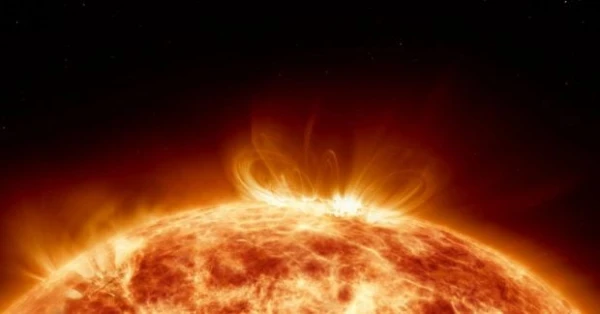
In about five billion years, our Sun will completely exhaust its hydrogen reserves in its core. This will lead to the cessation of nuclear fusion, which converts hydrogen into helium and is the primary source of solar energy.
As a result, the external pressure counteracting the gravitational collapse of the Sun will disappear. The core of the star will begin to contract, while its outer layers, where fusion will still continue, will expand by about a hundred times, possibly even more than their current width.
This will be the red giant phase. During this period, the Sun may engulf all the rocky planets of the Solar System, including Earth, up to the orbit of Mars.
The red giant phase for the Sun will be relatively short, expected to last only about one billion years. Gradually, the outer layers of the star will cool and disperse into space.
After them, only a nebula of former stellar material will remain, surrounding the core of the Sun. This core will transform into a bare, slowly cooling stellar remnant known as a white dwarf.
This is how the life cycle of all stars with a mass comparable to that of our Sun concludes.
Recently, scientists studying stars have begun to investigate the internal structure of red giants using the "starquake" method. This approach is analogous to how Earth seismologists use seismic waves to study the depths of our planet.
Such studies have revealed the presence of magnetic fields in the cores of red giants. Meanwhile, white dwarfs, as observations show, possess magnetic fields on their surfaces.
Lukas Ainraimhof and his colleagues are convinced that the fossil field model of stellar magnetism can unite these magnetic fields observed at two different stages of stellar evolution. This is particularly noteworthy given that this theory has somewhat lost its popularity among the scientific community in recent years.
"Since a white dwarf is a bare core of a red giant that has shed its outer layers, these different observations essentially study the same region of the star's interior at different stages of evolution," emphasized Ainraimhof. He continued, "If the magnetic field observed during the red giant phase matches that which evolves and is observed on the surface of the white dwarf, then the fossil field theory can explain and connect these observations."
Ainraimhof and his team hypothesize that after the red giant phase, when the star sheds its outer layers, characteristic magnetic "imprints" remain on the surface of its successor – the white dwarf.
A key aspect here is the degree of magnetism in the core of the red giant. "To link the magnetic fields observed on the surfaces of old white dwarfs with those found in the cores of their predecessors – red giants, a significant portion of the star must be magnetized," Ainraimhof explained.
He added, "However, this does not mean that stars are magnetized more strongly, but only that the magnetic fields must encompass a larger part of their core at early stages."
The research team also discovered how the evolution of a star affects the configuration of its magnetic field. They found that instead of being concentrated in one point, the field forms a segmented structure resembling the surface of a basketball.
This structure turns out to be stronger at the surface of the star than in its core. All these discoveries could significantly enhance scientists' understanding of the future of the Sun, as well as the overall state of our star deep beneath its visible surface.
"We still do not know whether the core of the Sun is magnetic. Although it is our own star, we are practically blind to what is happening at its center," admitted Ainraimhof. He continued, "Current predictions suggest that the core of the Sun is not magnetic. But if it turns out that this is not the case, this information will change all our knowledge and all the models on which we based our work. Given how little we know at this stage, our research suggests that stars are likely all magnetic. But we cannot always detect this magnetism."
Following the path outlined by this team, scientists may also conclude that our star, which is 4.6 billion years old, may have a bit more time than currently assumed.
"If the Sun can somehow transfer hydrogen from its outer layers to its core, it could live longer. One way to do this could be strong magnetic fields," Ainraimhof suggested. He also warned, "However, magnetic fields can lead to a completely different outcome."