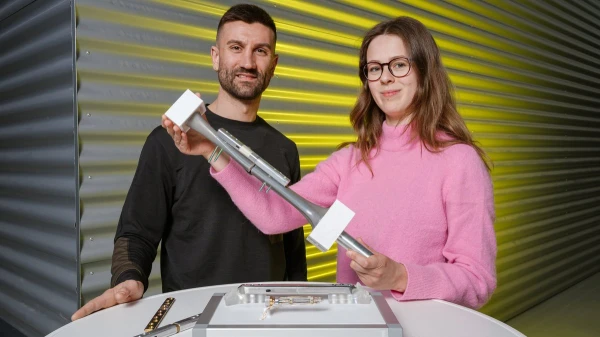
Scientists at Saarland University have made a breakthrough by creating innovative "smart" implants. These devices not only fix the fracture but also actively monitor the healing process, stimulating bone tissue regeneration.
At Saarland University, an interdisciplinary team of engineers, medical researchers, and IT specialists has presented a unique development. They have created "smart" implants that promise to radically change the approach to fracture treatment.
These high-tech devices not only stabilize the damaged bone but also continuously monitor the healing process. Moreover, if necessary, they can actively support and accelerate the recovery process.
Heart of the Technology: Nitinol Wires
At the core of this innovation are bundles of ultra-thin nickel-titanium (nitinol) wires. They serve a dual function: acting as micro-actuators while also being built-in position sensors.
Nitinol is known for its remarkable shape memory effect. When heated, for example, by electric current, this alloy changes its crystalline structure and contracts. Upon cooling, it returns to its original state.
The large number of wires in the bundle ensures incredibly rapid cooling, allowing them to make precise and quick movements. These can be both contractions and vibrations with an amplitude of 100-500 micrometers, effectively stimulating the growth of new tissues.
Intelligent Monitoring and Self-Diagnosis
The electrical resistance of nitinol wires changes with any deformation, paving the way for system self-diagnosis. Each mechanical change is matched with a specific resistance value, creating a unique "fingerprint."
This valuable data is used to train neural networks. Artificial intelligence can recognize signal patterns, accurately assess stiffness in the fracture area, and monitor the formation of new bone tissue, eliminating the need for frequent X-ray examinations.
The system also allows for the establishment of an individual and safe load limit for each patient. This ensures optimal conditions for recovery, preventing excessive stress on the healing bone.
Adaptation to the Healing Process
In the early stages of healing, the implant provides maximum strength and stabilization of the fracture. However, as the bone heals, it can switch to a more compliant and flexible mode.
The prototype of this remarkable device was successfully presented at the Hannover Fair. In the near future, there are plans to implement wireless data transmission from the implant directly to a smartphone, allowing patients and doctors to manage it through a mobile application.