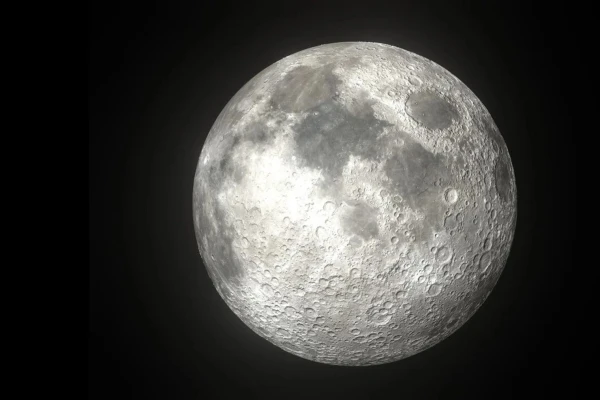
Chinese scientists have discovered a new lunar mineral in a meteorite that arrived from the Moon. It has been named "cerium-magnesium-chanthesite" and could change LED technologies on Earth.
Scientists from the Chinese Academy of Geological Sciences have discovered and identified a new 11th lunar mineral. It has been named "cerium-magnesium-chanthesite." Chang'e is the Chinese goddess of the Moon. The new lunar mineral exhibits a characteristic fluorescent effect, and the particle size ranges from three to 25 micrometers. This is smaller than the diameter of a human hair. This glassy mineral could change LED technologies on Earth, writes Focus.
Cerium-magnesium-chanthesite was found in the first lunar meteorite discovered in China. The spherical meteorite weighs only 44 grams.
Scientists described the new lunar mineral as a colorless, transparent, and structurally fragile material. Although its particle size is very small, its physical properties could have significant implications for our technologies.
A distinctive feature of the new lunar mineral is its pronounced fluorescence. Scientists believe that this property could make it particularly valuable in the development of more efficient light-emitting diodes (LEDs). Fluorescent materials play a central role in the operation of LEDs, affecting brightness, color rendering, and energy efficiency.
The new chemical compound could enable the creation of LED technologies that are both more powerful and less energy-consuming than existing ones.
Scientists say that this mineral was formed on the Moon under conditions that likely have never existed on Earth. However, if such a mineral is found on our planet, it could change our understanding of its geological history.
Of course, no one can currently mine minerals on the Moon. This is due to high costs and the need to create unique mining technologies.
But Chinese scientists will attempt to reproduce the properties of the lunar mineral in laboratory conditions. If successful, it would then be possible to discuss its application in the development of future LED technologies.