
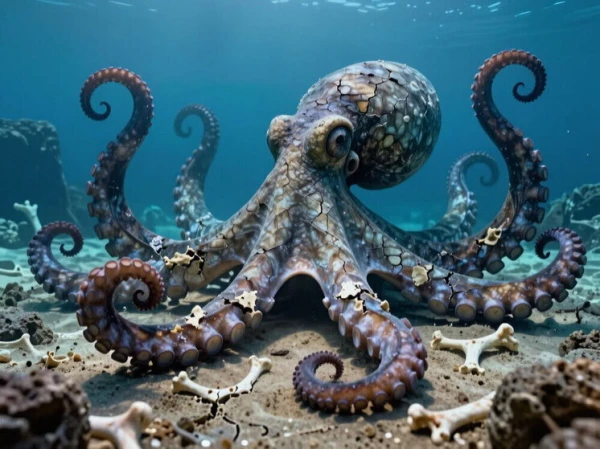
According to recent scientific data presented in the journal Science, one hundred million years ago, the marine expanses of Earth may have been home to incredibly large octopuses that reached colossal sizes.
A new study published in the prestigious journal Science sheds light on the astonishing past of our planet. One hundred million years ago, during the age of dinosaurs, the oceans of Earth may have been home to truly gigantic octopuses.
These ancient inhabitants of the deep seas were likely formidable and powerful predators. Their strong tentacles served to securely capture prey, while their beak-like jaws allowed them to easily crush the shells and bones of other marine creatures.
By studying the well-preserved fossils of these octopuses' jaws, scientists reached a staggering conclusion: their sizes could reach up to 19 meters. This makes them potentially the largest invertebrates ever known to science.
What Jaws Can Tell Us About the Brain
For many years, paleontologists held the view that the dominant marine predators were vertebrates, such as fish and reptiles. Invertebrates, including octopuses and squids, were relegated to a secondary role in the food chain.
However, researchers from Hokkaido University in Japan challenge this established viewpoint. The analysis of the fossilized jaws of giant octopuses allowed them to conclude that these creatures were capable of crushing the shells and skeletons of even large fish and marine reptiles.
According to their data, the body size of these ancient octopuses varied from 1.5 to 4.5 meters. Considering the length of their powerful tentacles, the total length of these marine giants could reach from 7 to 19 meters.
Even by modern standards, these are colossal sizes, especially for invertebrates. Another curious feature of ancient octopuses is the uneven wear on the right and left sides of their fossilized jaws.
This fact suggests that the animals likely preferred to chew on one side. According to scientists, such complex feeding behavior is strong evidence of a well-developed brain.
A Fearsome Predator
Modern octopuses impress with their ingenuity, ability to solve complex problems, and sophisticated hunting tactics. These qualities were likely also present in their ancient relatives.
The largest living species, the Giant Pacific Octopus, boasts a tentacle span of over 5.5 meters. There are even videos showing these marine predators successfully dealing with sharks over a meter long.
"With their suckers and tentacles, they can firmly grasp this animal — and it can no longer escape," explains Christian Klug, a paleontologist at the University of Zurich, who closely studied the Japanese research.
Nevertheless, many questions about the giant octopuses of the past remain unanswered. Experts are still only speculating about the exact shape of these creatures, the size of their fins, or their speed of movement.
Scientists have also failed to find fossils that could reveal the contents of these animals' stomachs. Such findings would allow for more accurate conclusions about their diet.
Dr. Nick Longrich from the University of Bath suggests that their primary prey were ammonites, ancient mollusks. However, like modern octopuses, these giants may have fed on anything that crossed their path and occasionally attacked other sea inhabitants.
"It will take a long time before we figure this out," he believes. "Right now, it's a mystery."















Leave a comment