
The first half of the 1960s accustomed Soviet citizens to the fact that news of space launches was always filled with joy and triumph. But in April 1967, they heard something different for the first time.
“The spacecraft was descending at high speed”
From a TASS report: “When the main parachute’s canopy opened at an altitude of seven kilometers, preliminary data indicates that due to the twisting of the parachute lines, the spacecraft was descending at high speed, which was the cause of V. M. Komarov's death.
The untimely death of the outstanding cosmonaut, test engineer of spacecraft Vladimir Mikhailovich Komarov, is a heavy loss for the entire Soviet people.”
The Soviet Union plunged into mourning. Instead of the customary hero's welcome in Red Square, there were funerals. Vladimir Komarov became the first conqueror of space to perish during a flight.
Official reports stated that the test flight program of “Soyuz-1,” piloted by Komarov, was completed in full. In reality, the situation was different.
The Race to the Moon
The spacecraft, which was initially part of the Soviet manned lunar program, was proving difficult. A whole array of system failures was recorded during unmanned launches. However, there was no time to refine “Soyuz” — the lag behind the Americans was becoming increasingly obvious.
In April 1967, the USSR planned a significant leap — following “Soyuz-1,” “Soyuz-2” was set to launch with a crew of three. After that, the ships were to dock, and two cosmonauts from “Soyuz-2” in spacesuits would transfer to “Soyuz-1” through open space. All of this was part of rehearsing elements of the Soviet “lunar mission.”
Vladimir Komarov was 40 years old, and unlike most of his fellow cosmonauts, he had not only experience as a military pilot but also an engineering education. In fact, engineer Sergey Korolev valued Komarov so highly that he offered him a position in his design bureau.
“There’s a ninety percent chance the flight will be unsuccessful”
Komarov was the commander of “Vostok-1” — the world’s first spacecraft with a crew of three. That flight was also extremely risky but ended successfully.
But with “Soyuz,” everything was much more complicated. Shortly before the launch, while talking with a friend, Komarov calmly said: “There’s a ninety percent chance the flight will be unsuccessful.”
However, he was a top-class professional and understood perfectly well — the flight would take place one way or another. And for any other cosmonaut without the engineering knowledge that he possessed, it would be much more difficult.
“Soyuz-1” successfully launched from Baikonur on the night of April 23, 1967. But almost immediately on orbit, major problems began. One of the two solar panel arrays did not open, and the spacecraft began to experience a shortage of electricity. All attempts to open it were unsuccessful.
Major Problems
There was a proposal, despite everything, to launch “Soyuz-2,” which had Valery Bykovsky, Alexey Eliseev, and Evgeny Khrunov as crew members. The ships were to dock, after which Eliseev and Khrunov, exiting into open space, could manually open the unfortunate panel.
After long discussions, it was decided that such an attempt under the current conditions would be too adventurous. The flight of “Soyuz-1” was decided to be terminated.
When Komarov was given the command to prepare for descent from orbit, it turned out that the ion orientation sensors had failed. There was only one chance left: to orient the spacecraft manually, aligning the spatial position of “Soyuz” with the Earth. The task was very difficult, but the cosmonaut managed it.
Survival Was Impossible
However, Vladimir Komarov could not influence what happened during the final stage of the flight. The extraction parachute at an altitude of 7 km (at a speed of about 220 m/s) failed to extract the main parachute from the compartment; at the same time, the backup parachute, which successfully deployed at an altitude of 1.5 km, did not fill because its lines wrapped around the untriggered extraction parachute of the main system.
As a result, the descent module struck the ground at a speed that precluded the survival of the cosmonaut. After that, a severe fire broke out at the crash site, effectively destroying what remained of “Soyuz-1.”
The exact cause of the problems with the parachute system was never established. It was suggested that the compartment housing the main parachute could have been deformed due to pressure changes. According to another version, the parachute could have stuck due to violations of technology and haste during flight preparation.
The death of Vladimir Komarov became a sobering factor for those who might have thought that conquering space would be an eternal celebration. The tragedy of “Soyuz-1” showed the true cost of humanity's journey into the universe.
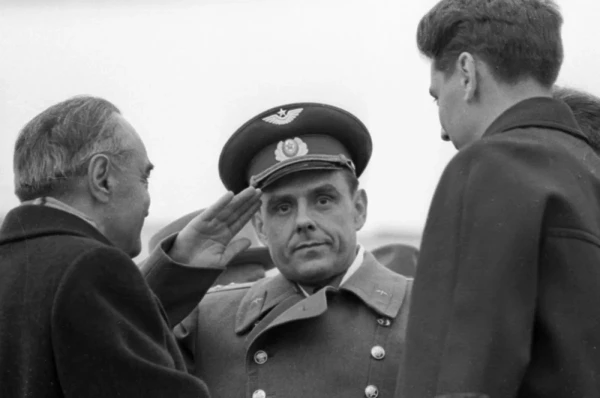
In the photo: The ceremonial meeting of the crew of the spacecraft “Vostok-1” (V. Komarov, B. Egorov, K. Feoktistov). The commander of the spacecraft, Vladimir Komarov (in the center), reports to the Chairman of the Presidium of the Supreme Soviet of the USSR, Anastas Mikoyan, on the completion of the flight. To the right is Boris Egorov. Vnukovo Airport








Leave a comment