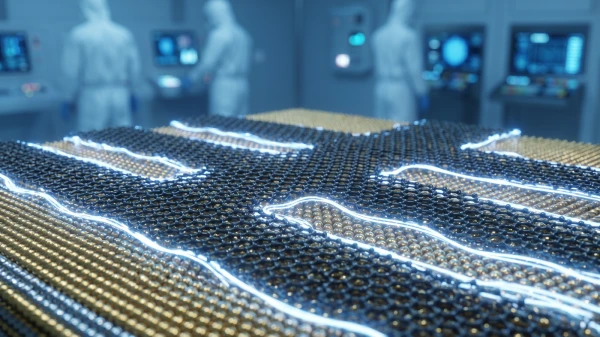
This innovative development opens exciting prospects for the creation of flexible electronics, smart clothing, and powerful quantum systems that require unprecedented precision.
Scientists from the University of Birmingham, the University of Warwick, and the University of Vienna have presented a revolutionary development that could change the creation of electronic materials for the future. Their innovative approach allows for the formation of electronic components in the form of molecular-scale nanostrips with incredible atomic precision.
The key feature of this technology is the ability to assemble such structures directly on a metallic surface, ensuring perfect shape and specified structure. Project participants emphasize that traditional chemical methods struggle to achieve such precision at the molecular level.
This groundbreaking technology promises to become a cornerstone for the development of complex and ultra-miniature electronics. Researchers enthusiastically note that the new method allows for control over the sizes and properties of electronic elements literally at the atomic level.
Such a level of control is critically important in areas where the accuracy, stability, and repeatability of material structure play a decisive role. In these sensitive systems, even the slightest deviation in configuration can radically change the characteristics of the device.
The spectrum of potential applications for this development is impressive in its scope. It encompasses smart clothing, revolutionary flexible electronics, and, of course, quantum computing, where materials with precisely defined electronic properties are required.
Essentially, this is not just another device but a powerful technological platform capable of becoming the foundation for a whole generation of future electronic components. James Lawrence, one of the project participants, aptly characterized this development as "a new tool for creating electronic materials with atomic precision."
He emphasized that the unique ability to grow nanostrips directly on a metallic substrate allows for structures with unprecedented clarity, which previously seemed almost impossible.