
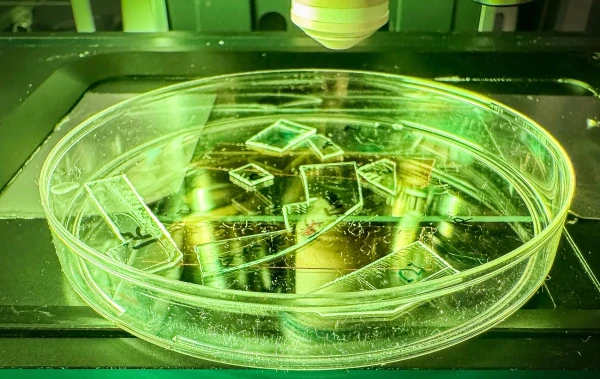
Researchers from RMIT have made a real breakthrough by developing an ultra-thin acrylic film whose nanostalks literally tear apart viruses upon contact. Remarkably, during testing, this innovative surface incapacitated about 94% of viral particles within an hour.
Australian scientists from RMIT University have presented an astonishing development to the world: a thin and flexible plastic film capable of physically damaging viruses as soon as they touch its surface. This is not just a chemical coating, but an innovative acrylic material embedded with nanostalks.
These microscopic structures literally grab the viral envelope, stretch it to its limits, and cause complete rupture. Scientists see this development as a powerful tool for significantly reducing the transmission of infections through frequently used surfaces.
Effectiveness in Action
Such a film could find applications everywhere: from smartphone screens and computer keyboards to critically important hospital equipment. During laboratory tests, the team applied the human parainfluenza virus type 3 (hPIV-3), known for its ability to cause bronchiolitis and pneumonia.
The results were impressive: just one hour after contact with the new surface, about 94% of viral particles were either completely destroyed or damaged to the extent that they lost their ability to replicate and infect. This opens new horizons in the fight against the spread of diseases.
Availability and Prospects
The lead author of the study, graduate student Samson Mah, emphasized that the choice of inexpensive and flexible plastic was not accidental. This will facilitate easy industrial production and make the technology accessible. According to him, in the near future, such film could be used to cover "phone screens, keyboards, and hospital tables," ensuring the destruction of viruses without the use of aggressive disinfectants. This will significantly simplify maintaining hygiene.
Co-author of the study, Professor Elena Ivanova, added that their team has already expressed readiness to collaborate with companies. The goal is to scale this unique technology and implement it into everyday life.
Key Discoveries in Geometry
One of the most important discoveries during the work was the understanding of the role of surface geometry. It turned out that for effective destruction of viruses, the distance between the nanostalks is critically important, rather than their height. The most powerful antiviral effect was demonstrated by structures with a gap of about 60 nanometers. As the distance increased to 100 nanometers, the film's activity decreased, and at 200 nanometers, the antiviral effect virtually disappeared.
Now scientists plan to expand their research by testing the film's effectiveness against smaller and non-enveloped viruses. They also need to determine how the material will perform on curved surfaces, which will open new possibilities for its application.















Leave a comment