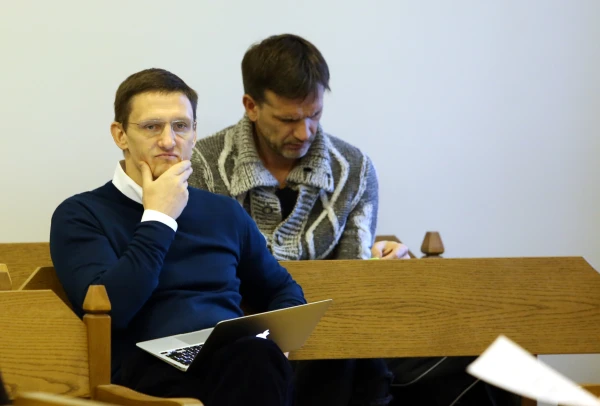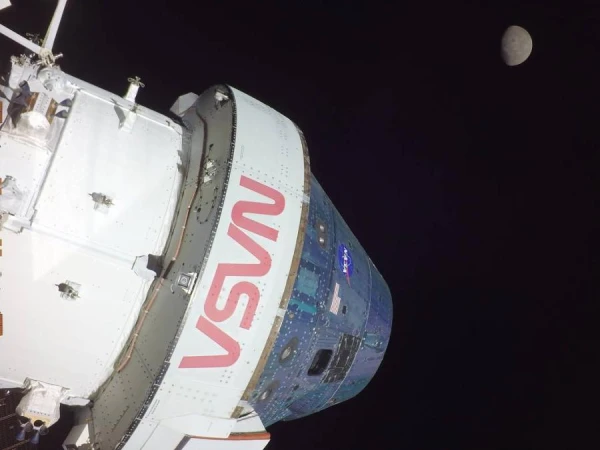
The mission of the National Aeronautics and Space Administration (NASA) 'Artemis II' marks a new stage in manned space flights, returning to lunar exploration after more than a 50-year hiatus, said Ilmars Eglitis, a leading researcher at the Institute of Astronomy of the Faculty of Exact Sciences and Technologies at the University of Latvia, to the LETA agency.
This is the first manned mission on such a trajectory since the Apollo program. Prior to this, lunar exploration was mainly limited to unmanned flights or activities in low Earth orbit.
The expert noted that this mission is primarily a stage of testing and preparation so that subsequent flights can safely land on the Moon, especially in the vicinity of its south pole. In the long term, this is also related to possible flights to Mars.
He also emphasized that this mission concludes a long hiatus in manned flights to more distant celestial bodies. For a long time, such missions were not conducted, but now a new spacecraft has been created that makes them possible again.
At the same time, he reminded that human presence in space remains a challenging task. Manned flights must ensure the conditions necessary for human life, including breathing, temperature, and protection from the space environment.
According to him, this mission is also notable for the distance achieved — the astronauts traveled more than 500,000 kilometers from Earth, which is one of the greatest distances ever reached by humans. This allowed for testing both the technologies and the human body's ability to withstand such conditions.
A particularly challenging stage is the return to Earth. Upon re-entering the atmosphere, the capsule reaches high speeds and experiences extreme heating and overloads. The researcher explained that technology comparatively withstands such conditions more easily, but the human body is more sensitive, so complex technical solutions are required to ensure the safety of the astronauts.
Also, during the return, communication with Earth is briefly interrupted, as a heated layer of gases forms around the capsule, blocking radio signals. In the future, solutions for this phenomenon need to be sought, noted Eglitis.
Although the mission was generally successful, it did not go without technical problems, and in the future, it is especially important to consider the crew's ability to act independently, the researcher added, emphasizing that problems can arise in space that cannot be anticipated in advance.
Eglitis also noted that space exploration is increasingly linked to geopolitics — there is competition for influence and technological leadership in space. "One could say that the struggle for leadership in space has resumed," he acknowledged, comparing the situation to the Cold War rivalry between superpowers.
As reported, the astronauts of NASA's 'Artemis II' mission, who made the first flight around the Moon since 1972, successfully returned to Earth.
The four astronauts of 'Artemis II' in the 'Orion' capsule — NASA astronauts Victor Glover, Reid Wiseman, Christina Koch, and Canadian astronaut Jeremy Hansen — splashed down in the Pacific Ocean near San Diego on Friday at 5:07 PM local time (Saturday at 3:07 AM Latvian time), as planned, NASA reported.
After the splashdown, teams of NASA and U.S. Department of Defense specialists helped the astronauts exit the capsule, after which they were flown by helicopter to a ship.
NASA Administrator Jared Isaacman personally welcomed the crew and congratulated them on a "truly historic achievement." The astronauts waved and smiled at the cameras, also giving thumbs up.
NASA reported that the crew is "healthy and happy." They will now undergo medical examinations before returning to Houston.
U.S. President Donald Trump described the lunar mission as "impressive" and the splashdown as "perfect" on his platform "Truth Social."
Canadian Prime Minister Mark Carney congratulated the crew on their return, calling it a "historic feat."
The splashdown was a complex maneuver, during which the capsule reached speeds of around 38,400 kilometers per hour at times, subjecting the astronauts to extreme physical stress.
A special heat shield protected the astronauts from the extreme heat the capsule experienced during re-entry into Earth's atmosphere.
It was planned that communication with the mission control center would be interrupted for about six minutes. After that, the capsule slowed down with the help of parachutes before falling into the Pacific Ocean.
The 'Artemis II' mission launched last Wednesday, and the crew set a new record for the distance traveled by humans in space.