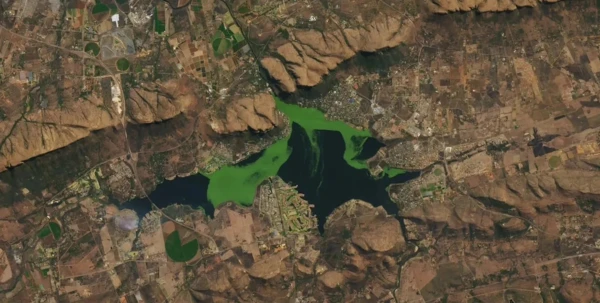
A satellite image shows a deadly, bright green mass slowly creeping across a South African reservoir.
A satellite image taken in 2022 shows a thick carpet of blooming algae and invasive aquatic plants spreading across the surface of the reservoir at the Hartbeespoort Dam in South Africa. Scientists warn that this green mass is toxic and capable of depleting oxygen levels in the water, writes Focus.
The reservoir is located at the Hartbeespoort Dam, built in the 1920s about 40 kilometers west of Pretoria. The water body is situated south of the Magaliesberg mountains, which are partially visible at the top of the image, and is fed by the Crocodile River flowing through nearby peaks. In addition to providing fresh water to nearby towns and farms, it is used for recreation, including fishing and water sports.
According to scientists, seasonal algal blooms are observed in most large water bodies when photosynthetic algae, or cyanobacteria, rapidly multiply and spread across their surface. A change in weather or nutrient influx serves as a catalyst.
However, the Hartbeespoort reservoir is in a constant state of "hyper-eutrophication" — in simple terms, there is a continuous excess of nutrients such as nitrogen and phosphorus. As a result, according to experts from NASA's Earth Observatory, blooms in this region occur significantly more frequently and intensely than previously thought. This frequent phenomenon leads to the release of toxic chemicals into the water and the formation of hidden "dead zones" that can cause mass fish kills.
The problem is that not only algae bloom on the surface of the reservoir. These green thickets also contain aquatic plants, including water hyacinths (Pontederia crassipes) and Salvinia minima, both of which are invasive and spread across the surface of the reservoir in large interwoven carpets.
According to oceanographer Bridget Siggers from NASA's Goddard Space Flight Center in Maryland, eutrophication occurs when too many nutrients are added to a water body, often due to human activity, and can lead to unnaturally large algal blooms. However, the consequences of failing to control plant growth are far more serious than one might assume. For example, some species of algae in the Hartbeespoort reservoir can produce toxins that need to be filtered out of the water to make it safe for drinking.
An even more serious problem is that excessive plant growth on the surface absorbs oxygen from the water, making it toxic for fish, which need to extract oxygen from the water through their gills for breathing. These areas of low oxygen water are often referred to as "dead zones," and when blooms spread widely, there are few safe places left for fish.
Observations show that the Hartbeespoort reservoir has been experiencing nearly continuous hyper-eutrophication since the 1970s, except for a brief period in the 1990s when a successful bioremediation program was implemented, but it was quickly discontinued due to high costs. As a result, algae continuously bloom, spreading and dying across the surface of the reservoir for decades. These events are so large that they can actually be observed even from space.