The crew of the Artemis II mission spacecraft is preparing for a historic flyby of the Moon, resulting in them being farther from Earth than all previous missions.
On Saturday, the astronauts of the Artemis II mission spacecraft prepared for their long-awaited flyby of the Moon, including studying surface features that they will photograph and analyze during the flight.
According to NASA, on Saturday the astronauts were approximately 272,000 km from Earth and 178,000 km from the Moon.
The next important milestone of the 10-day journey is expected on the night from Sunday to Monday, when the astronauts will enter the "lunar sphere of influence" - when the Moon's gravitational pull on the spacecraft will be stronger than that of Earth.
If all goes according to plan, during Orion's flight around the Moon, the astronauts will be able to set a record by traveling farther from Earth than any human has before.
According to NASA representatives, the astronauts started their day with breakfast, which included scrambled eggs and coffee, and woke up to the tune of the popular song "Pink Pony Club" by Chappell Roan.
"Morale on board is high," said Commander Reid Wiseman as the workday for the space crew began.
The father of two was in a cheerful mood partly because he had the opportunity to talk to his daughters from space.
"We are up here, we are so far away, and for a moment I was reunited with my family," he said at a live press conference. "It was the greatest moment of my life."
Wiseman, along with American astronauts Christina Koch and Victor Glover, as well as Canadian Jeremy Hansen, is making a historic journey around the Moon.
Wiseman described this feat as "Herculean," reminding that humanity has not achieved this in over half a century.
Later on Saturday, Glover was scheduled to conduct a manual piloting demonstration to provide NASA with more data on the spacecraft's performance in outer space.
After that, the crew planned to review their checklist to document their experience traveling around the Moon.
The astronauts underwent geological training to be able to photograph and describe lunar objects, including ancient lava flows and impact craters.
They will see the Moon from a unique vantage point compared to the Apollo missions of the 1960s and 70s.
Apollo flights operated at an altitude of about 70 miles above the lunar surface, while the Orion crew will be at just over 4,000 miles. This will allow them to see the entire surface of the Moon, including areas near both poles.
Never Before Seen
But the Artemis II astronauts have already uncovered entirely new perspectives.
"Last night we saw the far side of the Moon for the first time, and it was just amazing," said Koch, a mission specialist, during a live interview from space.
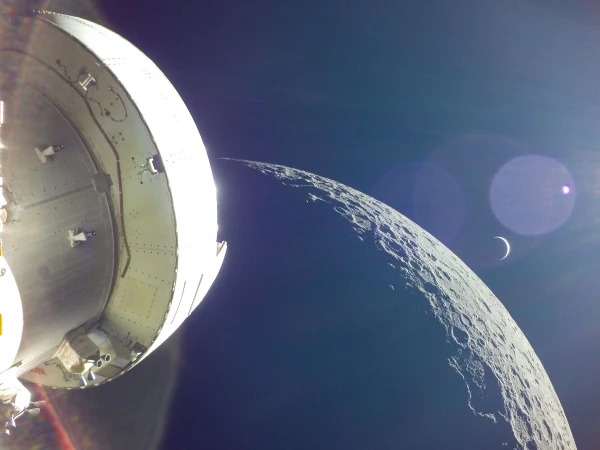
John Hanicutt, head of NASA's SLS (Space Launch System) program, shared a new image transmitted by the astronauts during a briefing on Saturday.
"In the far left corner, you can see areas of the Moon that until yesterday, people had never seen with their own eyes," Hanicutt said, explaining that this area was previously visible only to robotic spacecraft.
The Artemis II crew was busy photographing, including using smartphones that NASA recently allowed to be taken aboard spacecraft.