
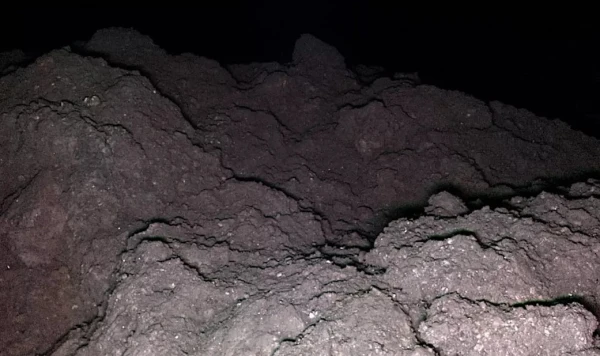
However, the celestial body is merely a random "transport" for their movement.
The study of soil samples from the asteroid Ryugu, delivered by the Japanese spacecraft Hayabusa 2, confirms the theory of panspermia. Specifically, scientists found all five basic "building blocks" necessary for the formation of life as we know it in the collected material. This means that asteroids can indeed be effective carriers of living matter — at least within our stellar system.
There was no sensation; scientists expected such a result, as all previous observations pointed to it. In 2025, NASA discovered that the asteroid Bennu contains all five nucleotide bases necessary for life to function. Even earlier, they were found on the Orgeya and Murchison asteroids, which fell to Earth in 1864 (France) and 1969 (Australia), respectively.
The following nucleotides were found on Ryugu: adenine, guanine, cytosine, thymine, and uracil. The first four are needed for DNA formation, while the last one is for RNA, which together form the basis of life. These nucleotides are transported by "carbonaceous" asteroids, which make up 75% of the total number in the Solar System.
But most importantly, Ryugu, like other asteroids, is not the "home" of the nucleotides; it is merely a random "transport" for their movement. Where and how life originated, which was then transported to Earth, remains a mystery. The Japanese team confirmed that these organic materials can form under prebiotic conditions anywhere in the Universe. It is also possible that a reverse process occurred on our planet — life emerged on prehistoric Earth and was then dispersed throughout the stellar system, only to eventually return back.














Leave a comment