
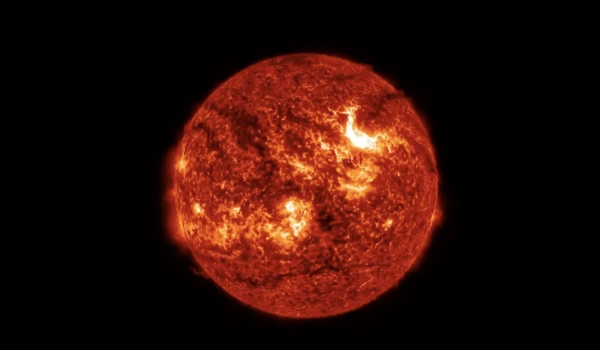
This research may help in more accurately forecasting space weather, which negatively impacts our technologies.
Scientists have confirmed that at a depth of 200,000 km beneath the visible surface of the Sun lies a powerful magnetic dynamo responsible for the formation of sunspots and contributing to the occurrence of intense solar flares and coronal mass ejections, writes Focus.
The Earth's magnetic dynamo (the mechanism by which the global magnetic field is created) is located in the outer core of our planet, where convection of molten iron generates electric currents.
The core of the Sun is a nuclear furnace of crushed atoms, and the inner two-thirds of the star form a radiation zone of gamma radiation, so the solar magnetic field cannot be generated there. Instead, all convection occurs in the outer third of the Sun, in the convective zone.
Previously, scientists wondered whether the Sun's magnetic dynamo is located in a narrow near-surface layer or possibly extends throughout the convective layer. But the most popular theory states that the Sun's magnetic dynamo is generated at the boundary between the lower part of the convective zone and the radiation zone. This boundary is called the tachocline, and scientists have found direct evidence that the Sun's magnetic dynamo is generated there.
To do this, the authors of the study used data from long-term observations of the Sun by the Solar and Heliospheric Observatory (SOHO) spacecraft and telescopes from the National Solar Observatory of the USA. They measure the changing nature of oscillations that propagate in the Sun's photosphere every 45–60 seconds.
The photosphere is the visible surface of the Sun, where sunspots (areas with cooler plasma and strong magnetic fields) and solar flares (large-scale emissions of radiation and energy) appear.
The oscillations are influenced by the structure of the Sun's interior, which is determined by the flows of plasma in the convective layer. The temperature and movement of these plasma flows affect the period and amplitude of the oscillations as they pass through the plasma flows before breaking through the photosphere.
Scientists have found that the plasma flows inside the Sun create a butterfly pattern that corresponds to how the position of sunspots changes over the 11-year solar magnetic activity cycle.
Measurements showed that this butterfly pattern arises from the tachocline located 200,000 kilometers below the sunspots on the photosphere. In the tachocline, the rotation of plasma drives an electric current that generates a magnetic field.
A better understanding of how the Sun's magnetic field is generated and how it contributes to the creation of sunspots and flares, as well as coronal mass ejections (streams of plasma ejected into space), may help in more accurately forecasting dangerous space weather. Eruptions on the Sun can send streams of charged particles toward Earth, which can disrupt satellites, communication systems, and power grids, as well as pose a threat to the lives of astronauts.














Leave a comment