
The report from the oversight body of the U.S. space agency, NASA's Office of Inspector General, shows that there are several very serious issues in the lunar program "Artemis."
NASA plans to conduct two astronaut landings on the Moon's surface in 2028 as part of the "Artemis-4" and "Artemis-5" missions. The launch of the "Artemis-2" mission, in which astronauts will orbit the Moon, is scheduled for April 1. In 2027, as part of the "Artemis-3" mission, NASA intends to test two lunar landers being developed by SpaceX and Blue Origin in lunar orbit. A new report from NASA's Office of Inspector General, which also addresses the lunar landers, indicates that crewed missions to the Moon will face serious risks, according to Focus citing Futurism.
According to the report, while NASA is taking steps to prevent catastrophic events, the space agency lacks the capability to rescue a crew stranded on the Moon if astronauts encounter a life-threatening emergency.
Overall, despite NASA's efforts to mitigate and prevent hazards associated with the landers, the report states that there are still gaps in the agency's risk reduction methodology.
The report also notes that unresolved issues remain regarding the design of the manual control system for SpaceX and Blue Origin's landers, which allows crew members to take control in case of an emergency.
In 2028, NASA plans to use one or two landers created by SpaceX and Blue Origin to land astronauts on the Moon. It all depends on which of these landers is ready first and passes testing in orbit.
The SpaceX lander is a variant of the Starship spacecraft, which serves as the second stage of the giant Starship rocket. This lander is 52 meters tall and must be refueled in low Earth orbit before it heads to the Moon. After refueling, the lander will fly to the Moon, where astronauts will transfer from the Orion spacecraft and descend to the lunar surface. However, SpaceX has yet to successfully launch Starship into space and land it, let alone achieve stable orbit or refueling in space.
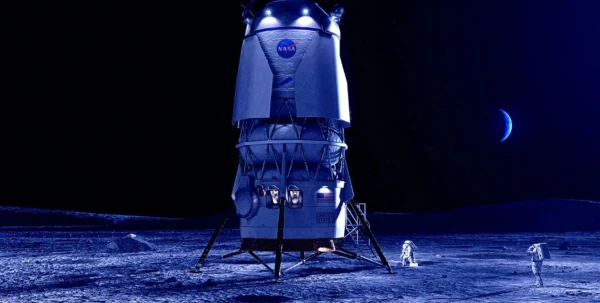
Blue Origin is developing the Blue Moon lander, which is 16 meters tall and also needs to be refueled in low Earth orbit before it travels to the Moon to pick up astronauts and deliver them to the surface of the Earth's satellite.
Which of the landers will be used in 2028 will be determined by tests in lunar orbit in 2027.
Landing astronauts from the Artemis program near the Moon's South Pole presents more serious challenges than landing near the lunar equator, as was done in the Apollo program, the report states. Steep slopes of up to 20 degrees at the Moon's South Pole create navigation and landing issues. Given the height of Starship, there is a risk that its inertia will be retained after landing, leading to the lunar module tipping over. Although the Blue Moon lander is smaller, it may also face risks during landing. In comparison, the tallest lunar lander from the Apollo program was only 7 meters tall.
Finally, the Starship lunar module will need to be equipped with an elevator to lower the crew to the surface, which could create an extremely dangerous situation in the event of an elevator failure, the report states.
















Leave a comment