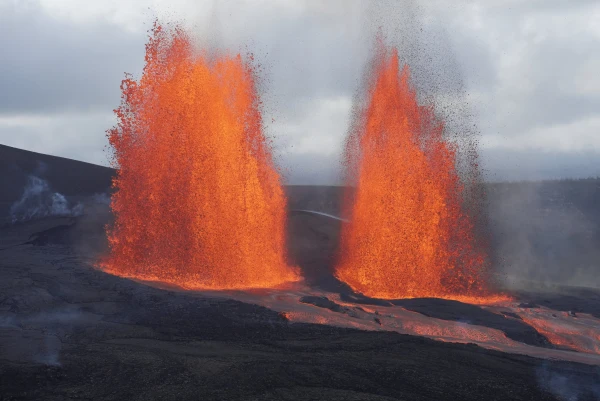
Recently, a powerful eruption of Kilauea Volcano occurred in Hawaii. During the eruption, a lava fountain reached a height of 540 meters — the highest recorded during the current period of activity that began in December 2024.
The wind carried volcanic material towards the viewing platforms for visitors and neighboring settlements, forming a noticeable layer of ash on the ground in several places, writes Focus citing IFLScience.
The event occurred at Kilauea, one of the most active volcanoes on Earth. It is located on the southeastern side of the Big Island of Hawaii. Scientists classify it as a shield volcano because its shape resembles a wide shield lying on the ground. Unlike steep volcanic cones, shield volcanoes form broad, gentle slopes created by numerous eruptions of liquid basalt lava that slowly flows down the sides of the volcano.
Kilauea is part of Hawaii Volcanoes National Park along with the much larger Mauna Loa. These volcanoes sit above a geological hotspot where hot mantle material rises to the surface. When heat melts parts of the Earth's crust, magma is formed, which eventually erupts through volcanic vents.
The current eruption period began on December 23, 2024, and has been accompanied by recurring short eruptions. Most of these occurred from two vents located within Halemaʻumaʻu — a crater in the volcano's caldera. These eruptions typically lasted less than 12 hours and were often separated by pauses lasting up to two weeks.
The latest event, dubbed Episode 43, began on March 10 and lasted about nine hours. During this time, powerful lava fountains ejected large volumes of volcanic debris into the air.
These debris are known as tephra — a general term for materials such as volcanic ash, pumice, and scoria ejected during eruptions. Larger debris typically falls near the volcano and slowly accumulates on its slopes, while smaller particles can be carried by the wind over long distances.
A significant amount of volcanic debris from this eruption settled near the Uwekahuna viewing platform and the Kilauea military camp area in Hawaii Volcanoes National Park. Other affected locations included sections of Highway 11 and the nearby community of Volcano Golf Course. These areas are located to the northeast of the eruption vents, where the wind carried the falling material.
During this eruption, more than 200 reports of tephra fall were recorded. While the debris can create impressive landscapes around volcanoes, they also raise concerns for residents who collect rainwater from roofs.
According to the U.S. Geological Survey, volcanic particles may contain small amounts of chemicals such as fluorine, arsenic, cadmium, chromium, copper, and lead. When debris settles on roofs, it can enter rainwater collection systems.
Experts recommend that residents disconnect downspouts before tephra falls and clean roofs and water tanks afterward. The U.S. Geological Survey explained that "these precautions effectively minimize impacts, and prolonged rain will naturally wash away any residual contamination."
After Episode 43 concluded, scientists observed a slight bulge at the summit of the volcano. This bulge indicates that magma may be moving upward again beneath the surface. According to the U.S. Geological Survey, computer models suggest that the next eruption episode could occur between March 28 and April 14.