This region is traditionally arid, and evaporation here significantly exceeds precipitation.
A new study shows that the salinity of water in the southern part of the Indian Ocean off the west coast of Australia is decreasing at an astonishing rate, with climate change cited as the main cause.
In an article published in the journal Nature Climate Change, scientists from the University of Colorado Boulder note that over the past six decades, rising temperatures have altered global wind patterns and ocean currents, bringing increasing amounts of freshwater into the southern Indian Ocean. These processes may disrupt the interaction between the ocean and the atmosphere, affect key ocean circulation systems that regulate the planet's climate, and potentially have serious impacts on marine ecosystems.
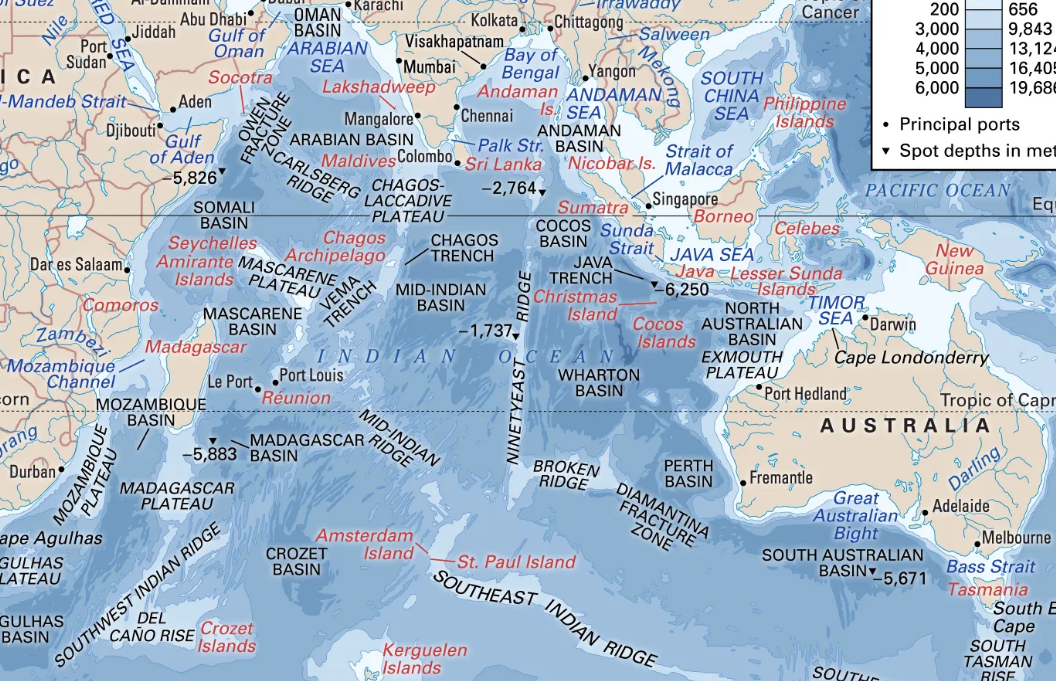
On average, the salinity of seawater is about 3.5%, which is roughly equivalent to dissolving one and a half teaspoons of salt in a glass of water. However, in a vast region from the eastern part of the Indian Ocean to the western part of the Pacific Ocean in the tropics of the Northern Hemisphere, surface waters are naturally less salty. Frequent tropical rains bring large amounts of freshwater here, while evaporation is relatively low. This area, known as the Indo-Pacific Freshwater Basin, is connected to a giant ocean circulation system that redistributes heat, salt, and freshwater across the planet. This thermohaline circulation directs warm, low-salinity surface waters from the Indo-Pacific region toward the Atlantic, contributing to a mild climate in Western Europe. In the North Atlantic, the water cools, becomes saltier and denser, sinks to depth, and then returns south through the depths of the ocean back to the Indian and Pacific Oceans.
Over the past six decades, observations have recorded changes in salinity off the southwest coast of Australia in the southern Indian Ocean. This region is traditionally arid, and evaporation here significantly exceeds precipitation, so the water has historically been very salty.
The team calculated that over the past six decades, the area of salty seawater has decreased by 30%, reflecting the fastest growth of freshwater recorded in the Southern Hemisphere. The freshening of the southern Indian Ocean is not related to local changes in precipitation. Data analysis and computer modeling have shown that global warming is changing the direction of surface winds over the Indian and tropical Pacific Oceans. These changes cause ocean currents to carry more water from the freshwater basin of the Indo-Pacific region into the southern Indian Ocean.
As the salinity of the water decreases, its density also decreases. Since freshwater is lighter and remains at the surface, while saltier and denser water lies deeper, the layers of the ocean become more stratified. The intensification of this stratification effect reduces vertical mixing – a process that typically allows surface water to sink and deep water to rise, distributing heat and nutrients throughout the ocean.
Previous studies have shown that climate change can slow part of the thermohaline circulation: the melting of the Greenland ice sheet and sea ice in the Arctic adds freshwater to the North Atlantic, disrupting the salinity balance necessary to maintain the movement of the oceanic "conveyor belt." The increase in freshwater volume in the Indian Ocean may further impact this system by delivering fresher water to the Atlantic. The reduction in vertical mixing also affects marine ecosystems. When nutrients from the depths do not rise to the sunlit surface, shallow-water organisms receive less food. Additionally, the weakening of mixing hinders the dissipation of heat from the surface layers to the depths, making the shallows even warmer for organisms already stressed by rising temperatures.
<iframe width="560" height="315" src="https://www.youtube.com/embed/ElcZ42f1MaU?si=mSzNLyZPcS2ds1xQ" title="YouTube video player" frameborder="0" allow="accelerometer; autoplay; clipboard-write; encrypted-media; gyroscope; picture-in-picture; web-share" referrerpolicy="strict-origin-when-cross-origin" allowfullscreen></iframe>