Scientists have only encountered fragments, which raised more questions than they answered.
Paleontologists have long debated the lifestyle of Spinosaurus. Some scientists believe that these dinosaurs were excellent swimmers capable of hunting in water. Others describe them as primarily coastal predators that caught fish in shallow waters. A new finding has settled the debate.
The history of studying Spinosaurus resembles a detective story with many white spots that hinder scientists from reaching a consensus about the lifestyle of these dinosaurs.
The remains of Spinosaurus (species Spinosaurus aegyptiacus) were first found in modern-day Egypt. They were described by German paleontologist Ernst Stromer in 1915, and they were stored in the Munich museum. However, most of the specimens were permanently lost during the bombing of Munich in 1944.
The destruction of the bones made the study of Spinosaurus extremely difficult for many decades. Since then, scientists have only encountered fragments, which raised more questions than they answered.
The key academic debate revolved around whether Spinosaurus could hunt in the open sea or if they were coastal shallow-water hunters. Furthermore, how did they obtain food? Remains of these predators have been found not only in coastal marine deposits but also in lake deposits, so such findings alone do not allow for a definitive determination of the lifestyle of these dinosaurs.
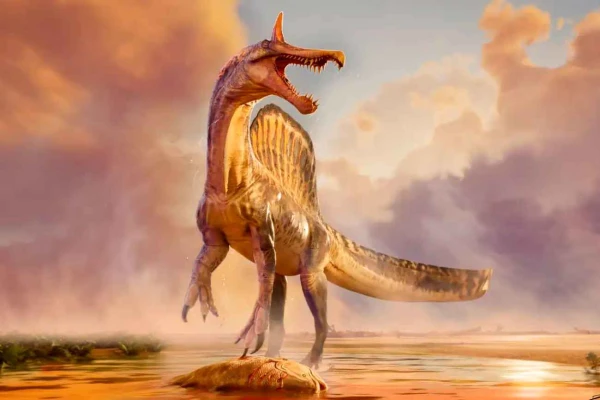
Many paleontologists are puzzled by the extremely high neural spines on the vertebrae of Spinosaurus, which are commonly referred to as the animal's "sail." Some specialists believe that Spinosaurus swam well and dove for fish, using the "sail" as a stabilizer. This viewpoint was even reflected in 2025 in the BBC documentary series "Walking with Dinosaurs," depicting the lizards as true aquatic monsters.
Other scientists argue that swimming with such a sail would be impossible—it would make the animal extremely unstable. In their opinion, Spinosaurus wandered through shallow waters like giant herons, snatching prey from the water with their long jaws.
A team of paleontologists led by Paul Sereno from the University of Chicago attempted to clarify this issue. To do this, the scientists traveled to Niger, to the Farak formation, where rocks aged 94-99 million years are located. Remains of Spinosaurus had previously been discovered there, so the researchers were hopeful. And they were not disappointed.
In 2019, a local guide led the researchers to a hard-to-reach area where they found several jaw fragments belonging to Spinosaurus, but due to the Covid-19 pandemic, the scientists could only return to the excavations several years later.
The second expedition exceeded all expectations. The paleontologists discovered a nearly complete skeleton belonging to a previously unknown species of Spinosaurus, as well as remains of long-necked sauropods.