
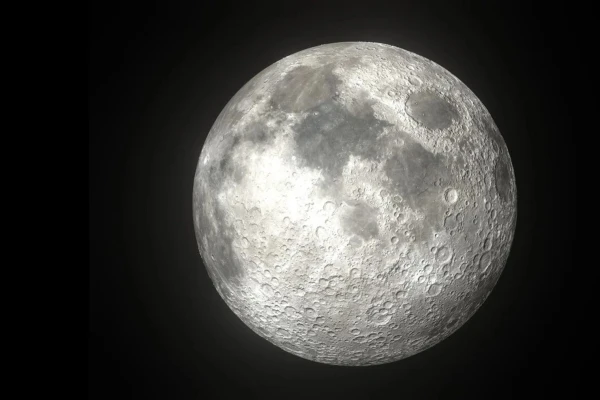
Scientists have discovered relatively recent geological activity on the Moon, and this finding may impact the return of humans to the Moon after more than 50 years.
No other world in the Solar System has tectonic plates and earthquakes like Earth. But that does not mean that earthquakes do not occur on these worlds. Scientists have known for over 50 years that such earthquakes occur on the Moon, and for about 15 years it has been known that the Moon is shrinking. It has already lost 50 meters in the last 200 million years. Now this data has been confirmed by new observations of the Moon. The study was published in The Planetary Science Journal, reports Focus citing IFLScience.
At the beginning of its 4 billion-year history, the Moon was a very geologically active world. But over time, its core began to cool and solidify. As the inner layer contracts, the Moon's crust cracks and deforms. Scientists have discovered faults on the surface of the Moon associated with this process.
These faults, as well as small ridges, were found on the surface of the dark basalt plains known as lunar seas. It turned out that these ridges and faults are related to relatively recent geological activity, particularly lunar earthquakes.
Although it is known that earthquakes occur on the Moon due to the gravitational pull of Earth, its internal structure, and meteorite impacts, scientists have discovered new sources of underground tremors.
Calculations by scientists showed that thousands of ridges in the lunar seas formed about 124 million years ago, while the faults formed about 105 million years ago. The study showed that these phenomena are interconnected by geological activity, and the most likely cause of both phenomena is the Moon's contraction.
The results of the study indicate that lunar earthquakes may occur in the areas of the lunar seas and that there may be more seismic threats to human exploration of the Moon than scientists previously thought.
Future crewed and robotic missions may provide new and more detailed information about the ongoing activity inside the Moon. For example, NASA plans to return humans to the Moon as early as 2028 as part of the Artemis program. A deeper understanding of seismic activity on the Moon will directly enhance the safety of these missions, scientists believe.
According to scientists, the Moon is shrinking due to geological processes caused by the loss of internal heat, leading to the formation of ridges and faults on its surface. At the same time, earthquakes are occurring on the Moon as a result of ongoing geological activity. This means that the Moon is not a dead world in geological terms. Space agencies will have to take this into account when planning landing sites for crewed and robotic missions on the Moon's surface, as well as when constructing future bases and colonies.














Leave a comment