
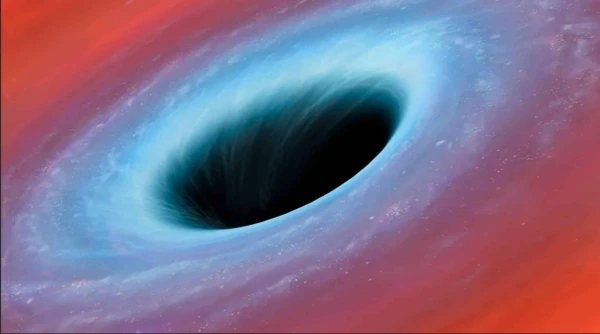
Sometimes the shell does not disperse but falls back onto the collapsing core.
In the Andromeda galaxy, a "quiet" death of a star was recorded: the object M31-2014-DS1 first flared in the infrared range and then completely extinguished in the optical — without an explosion. The star, according to astronomers, collapsed into a black hole, becoming one of the most convincing examples of a "failed" supernova to date.
Typically, the death of massive stars with an initial mass greater than 8-10 times that of the Sun is accompanied by brilliant supernova flashes. When the nuclear fuel in the core of such a star runs out, it collapses, forming a neutron star or black hole. In this process, a shock wave ejects the outer layers of the star into the surrounding space. Astronomers regularly observe these explosions even at intergalactic distances.
However, theoretical models have been predicting a different scenario for stellar death for several decades: if the shock wave is too weak, the shell does not disperse but falls back onto the collapsing core. In this case, instead of a dazzling supernova, the star simply "disappears," leaving behind a black hole.
This is the case that a group of scientists led by Kishalay De from Columbia University (USA) recorded in the Andromeda galaxy. To do this, the researchers analyzed new and archival data from the NEOWISE infrared sky survey, applying a method of image subtraction. This approach allowed them to identify variable sources, including the star M31-2014-DS1. From 2014 to 2016, its brightness in the average infrared range increased by 50%, after which it began to rapidly decline.















Leave a comment