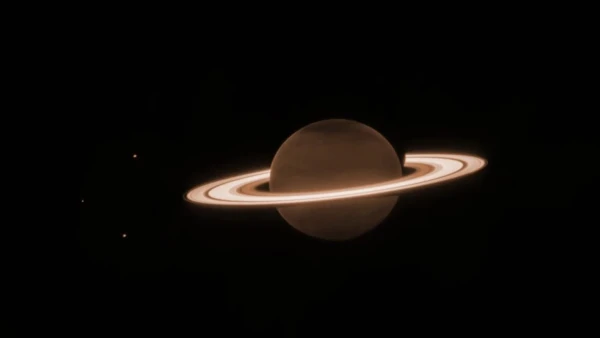
Titan may have formed as a result of the merger of two ancient moons. A similar collision between moons could have created the well-known rings of Saturn.
Scientists believe that Saturn's rings and its largest moon, Titan, may have formed as a result of collisions between the gas giant's moons. The study was published on the preprint server arXiv, reports Focus citing Phys.
For their research, astronomers used data from the Cassini spacecraft, which studied Saturn and its main moons from 2004 to 2017, the largest of which is Titan.
The Cassini spacecraft measured the internal mass distribution of Saturn, which determines the slow oscillation of the planet's rotation axis (precession). For decades, scientists believed that Saturn's precession period coincided with Neptune's precession period, allowing the gravitational interaction between the two planets to gradually tilt Saturn and give us a clear view of its rings.
However, Cassini's observations showed that Saturn's mass is somewhat more concentrated at its center than expected, changing the precession rate so that it no longer matches Neptune's rotation rate. To explain this, scientists suggested that Saturn once had an additional moon that was ejected after a close encounter with Titan and broke apart, forming the planet's rings.
In the new study, scientists used computer simulations to determine whether an additional moon could approach Saturn closely enough to form rings. The most likely outcome was a collision between the additional moon and Titan.
According to scientists, Hyperion, the smallest of Saturn's major moons, provided a crucial clue about the system's history. In simulations where the additional moon had an unstable orbit, Hyperion often disappeared. Scientists established that the connection between Titan and Hyperion has existed for several hundred million years. This is approximately the same period when the additional moon of Saturn disappeared. It is possible that Hyperion resulted from the breakup of this moon. If it and another vanished moon formed Titan, then this led to the formation of Hyperion.
The new model suggests that Titan formed as a result of the merger of two older moons: one was nearly the same size as Titan, while the other was smaller. This is indicated by Titan's surface features as well as its orbit.
If Titan formed from the merger of two moons, then where did Saturn's rings come from? More than a decade ago, scientists suggested that the rings are debris from collisions of moons located closer to Saturn. This idea was confirmed through modeling. The results showed that most of the debris would coalesce back into moons, while some debris would form Saturn's rings.
For many years, it was thought that the collisions of moons were caused by the Sun, but new research shows that this is another result of Titan's formation. Titan's eccentric orbit can destabilize the orbits of the inner moons. As a result, their orbits elongate, directing them toward collisions with neighboring moons.
Although it is unknown when this cataclysm occurred, it must have happened after Titan's formation, which aligns with the estimated age of the rings, around 100 million years.
NASA's Dragonfly mission, which will arrive at Titan in 2034, will help verify the conclusions of the new study.