
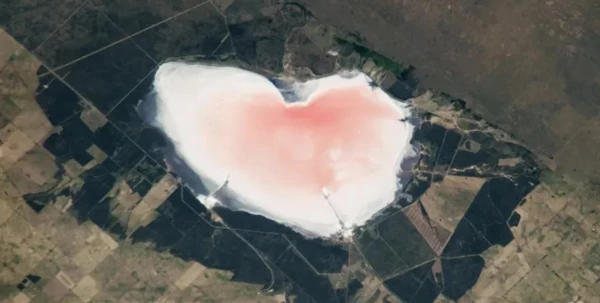
The photograph features a stunning pink salt lake in the shape of a heart in Argentina. NASA dedicated this photo to Valentine's Day.
NASA has released a photo taken by an unnamed astronaut aboard the International Space Station (ISS) dedicated to Valentine's Day. The photo shows a pink salt lake in the shape of a heart located in Argentina, as reported by Focus citing Live Science.
Salinas Las Barrancas is a shallow salt lake situated in the lowland area of Argentina in Buenos Aires Province. The lake's bottom is about 10 kilometers wide at its widest point, and it regularly fills with water after heavy rains. However, the water quickly evaporates due to the intense sunlight in the region, exposing the salt flats rich in crystal salt, which is harvested by the local population.
In this photograph, the lake appears almost empty due to its light pink hue, which results from an imbalance between the algae Dunaliella salina, thriving in most salt lakes on Earth, and other microorganisms in the water.
According to scientists, during the rainy seasons, the salinity level decreases because there is more water in the lake. When the salt concentration is lower, Dunaliella salina algae survive, and such salt lakes appear brownish-red. In the dry season, the water becomes very salty. The Dunaliella salina algae die off, and bacteria take their place. Then the water turns pink.
Local residents harvest up to 330,000 tons of salt from the salt flats twice a year, in the breaks between rainy seasons. Salt extraction is expected to remain profitable in this area for about 5,000 years, according to scientists' estimates.
The high salinity of Salinas Las Barrancas means that little can survive there. However, some salt-tolerant vegetation grows along the shores of the lake.
Colorful birds also inhabit the area, including bright yellow cardinals (Gubernatrix cristata) and bright pink Chilean flamingos (Phoenicopterus chilensis). These birds feed on small crustaceans rich in carotenoids. These are organic pigments produced by plants, algae, and bacteria.
These carotenoids come from the Dunaliella salina algae that the crustaceans feed on, naturally producing both red and yellow pigments. Without these pigments in their diet from birth, both species of birds would have different coloring: yellow cardinals would initially be red, and flamingos are born grayish-white.














Leave a comment