
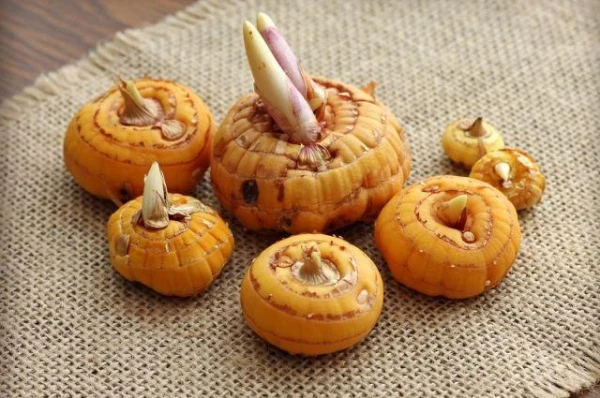
Gladiolus are propagated using corms and cormlets—offsets.
Gladiolus corms can produce flowering plants for 4-5 years, despite annual renewal. Aging typically occurs in five-year-old corms. Once the corms change from round to flat and bulbous with uneven bases, they should be replaced with new ones grown from offsets. Otherwise, they may perish during storage or, worse, after being planted in the ground. To accelerate the propagation of a valuable variety, the corm can be divided into parts with 1-2 buds and a portion of the base. The cuts are treated with charcoal powder, dried, and planted in beds. This way, 3-4 plants and an equal number of replacement corms can be obtained.
For varieties that produce few offsets, the corm can be divided or planted with the base facing up—in this case, it is recommended to remove the central shoot. To obtain young productive corms, the offsets need to be sown annually.
Seed propagation is used in gladiolus breeding to create new varieties; however, the traits of the original variety are not preserved in this process.









Leave a comment