Giant trees lowered the level of carbon dioxide on Earth.
Paleontologists from the Natural History Museum in London have revealed how representatives of ancient flora transformed from tiny beings into giants. The details, outlined in the journal New Phytologist, were aided by the fossil of the plant Horneophyton lignieri from Scotland, which is estimated to be 407 million years old.
Previously, it was believed that this ancient organism had developed an advanced system of internal "pipelines" (xylem and phloem), similar to modern plants. However, the application of 3D technologies helped to reveal an unexpected detail. It turned out that Horneophyton had a primitive, unified transport tissue. This tissue simultaneously transported both water and nutrients, without separating these flows into different types of cells.
This arrangement was only useful for small sizes – the plant itself reached a height of up to 20 cm. However, it became a significant evolutionary experiment. In fact, nature tested a prototype of a future complex structure here.
A significant step was made by Horneophyton's close relative – the plant Asteroxylon. It already had a clear division of functions: some cells specialized in lifting water, while others focused on distributing sugars. This became a biological breakthrough, allowing Asteroxylon to grow twice as large as its predecessor.
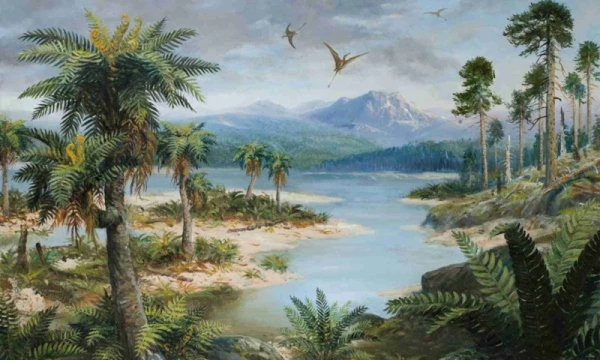
This principle laid the foundation for the construction of subsequent giants – ancient ferns and trees, which later changed the face of the planet.
The emergence of tall plants with a developed vascular system during the Devonian period significantly altered the Earth's climate, contributing to a decrease in carbon dioxide levels and affecting the processes of weathering of rocks (the breakdown of structure and changes in chemical composition).