The asteroid impact 66 million years ago triggered a spike in extinction, but it was offset by a surge of new species.
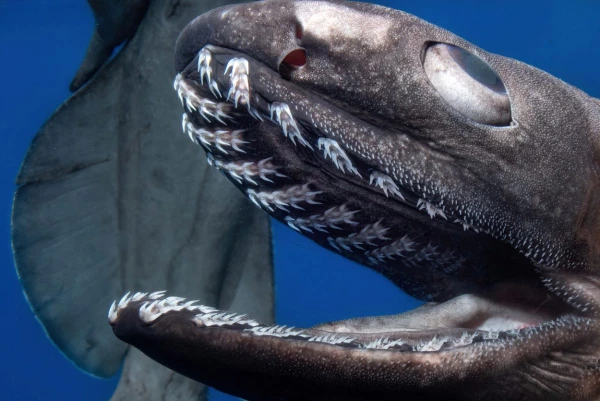
A group of researchers has debunked the classical theory of the randomness of species extinction using marine predators as an example. An analysis of the evolution of sharks and rays over the past 145 million years showed that the risk of species extinction directly depends on the duration of its existence: "newcomers" die much more often than evolutionary long-livers. Furthermore, the scientists established that the famous asteroid that wiped out the dinosaurs did not strike the ocean as hard as the subsequent climate change.
For a long time, the Law of Constant Extinction by Leigh Van Valen dominated evolutionary biology. It stated that the probability of a species' extinction does not depend on its age: old and young species are equally vulnerable to a changing environment. However, sharks have survived all five global mass extinctions and do not fit into this framework. Scientists needed to determine what exactly defines the resilience of these predators: constant adaptation (the "Black Queen" hypothesis) or accumulated stability.
The authors of the scientific paper published in the Proceedings of the Royal Society B (UK) compiled the FINS database, which contains over 20,000 records of fossils from all continents. The main difficulty lay in the incompleteness of the paleontological record: many species may have disappeared without leaving traces. To correct these gaps, the researchers used the ADE-NN neural network and Bayesian modeling (the PyRate method). This allowed them to reconstruct the actual dynamics of species birth and death, separating the signal from the noise.
The calculations revealed a pattern called "negative age dependence." The most dangerous period for any shark species turned out to be the first four million years of existence. If a species overcame this threshold, its chances of extinction rapidly decreased, and "old-timers" (species older than 14 million years) became virtually invulnerable to natural threats. This means that in the world of sharks, a successful strategy is not constant change, but conservatism and stability.
The analysis also helped rewrite the chronology of catastrophes. The asteroid impact 66 million years ago triggered a spike in extinction, but it was offset by a surge of new species filling the vacated niches. The real tragedy occurred during the transition from the Eocene to the Oligocene (about 34-38 million years ago), when global cooling and falling sea levels led to mass extinction, after which recovery did not follow.
The study showed that over the last 56 million years, the biodiversity of sharks and rays has been in a state of slow decline: old species are disappearing, and new ones are appearing too rarely to compensate for the losses. The data obtained help to understand why modern sharks are so vulnerable: by destroying young species, humanity is cutting off evolutionary lines at their most critical period, not giving them a chance to transition into the category of stable long-livers.