
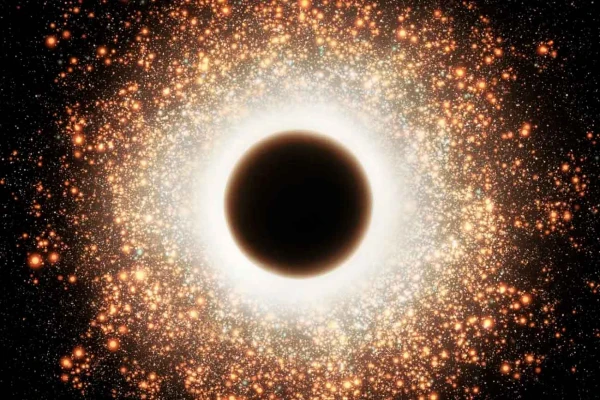
The spectrum of their radiation almost perfectly matches that of a so-called black body.
Among the most intriguing discoveries of the James Webb Space Telescope are compact objects dubbed "little red dots." They have only been seen in the farthest corners of the universe. Most formed in the first billion years after the Big Bang, and scientists had assumed that such sources represented small compact galaxies. However, an international team of astronomers came to a different conclusion. They suggested that the "little red dots" are actually black holes surrounded by a massive gas shell.
Since the launch of the James Webb Space Telescope in 2021, astronomers have had the opportunity to look back into the earliest era of the universe's history — the first billion years after its birth.
.jpeg)
It was during this time that strange objects were noticed, which immediately stood out from the usual picture. They appeared as very compact, bright, and yet red sources of light. There is nothing similar nearby in the modern universe.
The objects were informally named "little red dots" (Little Red Dots). The first attempts to explain their nature boiled down to two versions. Some scientists suggested that they were supermassive black holes surrounded by dense clouds of dust. Others considered them galaxies with abnormally high star density. However, the spectrum of radiation recorded by the telescope did not fit well with either hypothesis.
When the James Webb Telescope looked at these "little red dots," it did not just see brightness, but how the light was distributed. It registered the radiation of the outer shell (the surface of the emitting gas sphere). Scientists compare this to the "fingerprint" of the object.
Stars have a very smooth "fingerprint." A star shines like one solid glowing sphere — it has a surface, and light is emitted almost uniformly across different wavelengths. Therefore, the spectrum looks smooth, without sharp spikes.
Galaxies are quite different. A galaxy is a kind of "mix" of stars, clouds of gas, dust, and often a black hole at its center. Each of these components emits light in its own way. As a result, the spectrum becomes uneven, with many peaks and troughs.
By analyzing the radiation spectrum of the "little red dots," researchers noticed that it was too "neat": as if the telescope was looking at one huge star, rather than a complex system of billions of objects.
Thus, the "little red dots" quickly became one of the main mysteries of the James Webb era — the first major anomaly that showed that the early universe might have been structured quite differently than specialists expected.
In early 2025, an international group of astronomers led by Anna de Graaff from Harvard University in the USA proposed an alternative hypothesis. The scientists suggested that the "little red dots" are neither galaxies nor familiar black holes, but giant gas spheres, within which an actively growing black hole is hidden, known as quasar stars.
The mechanism of their emission is different from that of ordinary stars. Unlike regular stars that derive energy from nuclear fusion in their cores, the energy of a quasar star is thought to come from material falling into the black hole. That is, matter from the enormous gas shell falls onto the central black hole, and in the process, a colossal amount of energy is released.
This energy heats the surrounding gas, causing the entire "sphere" to glow: the total luminosity can exceed that of the sun by billions of times. As a result, an object is observed that outwardly resembles a star but operates on a fundamentally different "energy factory."
Now, having analyzed the largest sample to date of more than a hundred "little red dots," de Graaff's team concluded that the quasar star model best explains these objects. The astronomers studied how the brightness of light from the "little red dots" changes at different frequencies and understood that their radiation spectrum almost perfectly matches that of a so-called black body — an imaginary ideal surface capable of completely absorbing all electromagnetic radiation falling on it and emitting radiation of any frequency. This refers to the form of spectral distribution (spectral energy density), not that the objects physically represent ideal black bodies.
In other words, the radiation spectrum of the "little red dots" resembles the spectrum of a star and differs from the "peaked" spectra of galaxies, where light is emitted by many separate sources.
In September 2025, de Graaff and her colleagues discovered an object from the group of "little red dots" that stood out with a particularly sharp peak of radiation at a certain frequency, which could not be explained by either standard galaxy models or black hole models. This refers to the source RUBIES-UDS-154183. This case became another argument in favor of the new hypothesis.













Leave a comment