
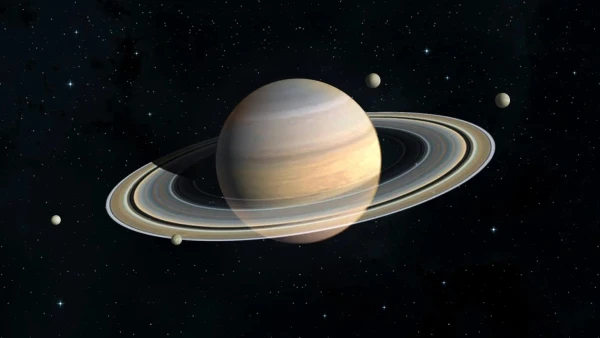
In the past year, astronomers have discovered more than a hundred previously unknown moons of Saturn and one new moon of Uranus. Scientists believe that not all moons of the planets have been discovered yet.
In 2025, astronomers discovered 129 new planetary moons in the Solar System: one around Uranus and 128 around Saturn. Now, Saturn holds the absolute record for the number of moons among all planets in the Solar System. Scientists believe that even if new moons are found, no other planet is likely to have more than Saturn, writes New Scientist.
Until March 2025, Saturn was the planet in the Solar System with the most moons. It was known that the planet had 146. This gas giant is known for its well-defined rings. Although other giant planets that orbit the Sun, such as Jupiter, Uranus, and Neptune, also have rings, Saturn's rings are the most visible.
However, in March of this year, astronomers discovered 128 previously unknown moons around Saturn. They are too faint and small, making them difficult to find previously. So far, these moons have not received official names. Thus, as of December 2025, Saturn has 274 moons. This is an absolute record that scientists believe will not be surpassed by any other planet in the Solar System, even if new moons are discovered.
For comparison, Jupiter ranks second in the number of moons. It is the closest gas giant to us and the largest planet in the Solar System. As of December 2025, Jupiter has 95 moons. It is worth noting that Venus and Mercury have no moons, Mars has two moons, Neptune has 16, and Earth has only one Moon. In total, as of December 2025, the planets of the Solar System have 417 moons.
The new moons of Saturn do not have a spherical shape like that of the Moon. They resemble potatoes several kilometers in size. Astronomers believe that they were captured by Saturn's gravity and did not form with the planet over 4 billion years ago.
Until August 2025, astronomers believed that Uranus, which is the seventh and second-to-last planet in the Solar System, had 28 moons. However, astronomers discovered a new small and faint moon, which has the preliminary designation S/2025 U1. According to scientists' estimates, its size is about 10 kilometers. This is the smallest moon of Uranus. Thus, as of December 2025, Uranus has 29 moons. It is likely to receive an official name in honor of a character from a Shakespeare play, as other moons of Uranus have been named in this manner.
Nigel Mason from the University of Kent, UK, says that many more new moons are likely to be discovered in the Solar System, especially around Neptune and Uranus, although the largest of them are probably already known.
The more moons astronomers find, the more information they gain about how such worlds formed. This data can be used to update models of planet formation, a process that is not as well understood as one would like, says Mason.















Leave a comment