
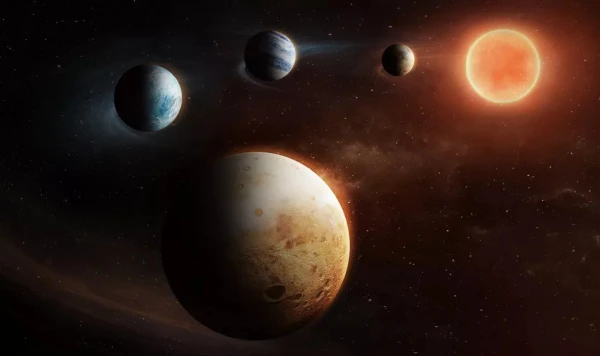
Rocky planets closer to their star lost their gas envelopes due to intense radiation.
An international group of astronomers has published the results of a study of an unusual exoplanetary system formed around the red dwarf LHS 1903, located about 116 light years from Earth in the constellation Lynx.
The system is the complete opposite of our Solar System, where the rocky planets — Mercury, Venus, Mars, and Earth — are closest to the Sun, while the gas giants Jupiter and Saturn are on the periphery. The ice giants Uranus and Neptune are even further out and consist of heavier volatile elements.
Such a "layout" is characteristic of many other planetary systems in our galaxy. It is explained by the fact that the rocky planets closer to their star lost their gas envelopes due to intense radiation, while those farther away retained theirs.
In the case of LHS 1903 and the four exoplanets orbiting it, the situation is exactly the opposite. Data obtained from the European Space Agency's CHEOPS satellite showed that the closest planet to the star is the rocky planet LHS 1903 b, while the two gaseous planets LHS 1903 c and d and the fourth rocky planet LHS 1903 e are on the outskirts of the system.
This contradicts previous notions of the "hierarchy" of planets in stellar systems — rocky planets are closer, and gas giants are further from their stars. The LHS 1903 system turned out to be, as it were, "inverted."
Scientists are investigating this unusual configuration and trying to find an explanation for it. Based on data from the CHEOPS satellite, they concluded that the exoplanets formed not simultaneously, but sequentially — that is, "from the inside out." Thus, LHS 1903 e could have formed when most of the gas in the planetary system had already been depleted.













Leave a comment