The stratospheric barrier that protects life on Earth from ultraviolet radiation has begun to recover.
European space researchers report that this year the ozone hole over Antarctica was the smallest and shortest-lived since 2019. They characterized this as a "promising signal" for the recovery of the ozone layer. According to the Copernicus Atmosphere Monitoring Service (CAMS), the ozone hole reached its maximum in September – 21 million sq. km over the Southern Hemisphere.
This is significantly less than the 2023 figure, when it reached 26 million sq. km, and the hole closed earlier than usual, already on Monday. Thus, this is the second consecutive year that the ozone hole has remained relatively small, following a series of larger and longer-lasting gaps observed from 2020 to 2023.
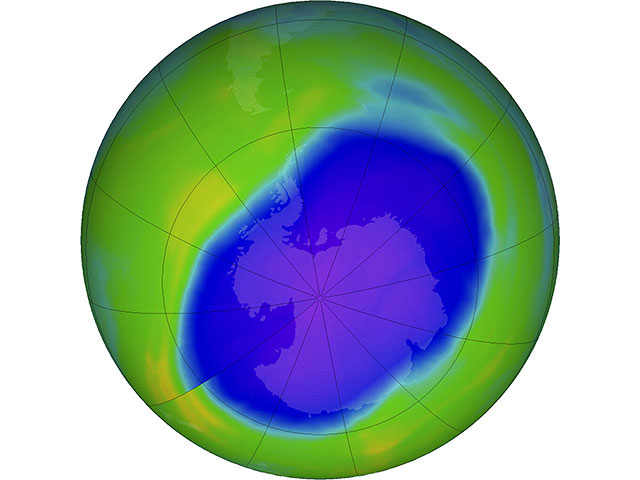
The ozone layer, a stratospheric barrier that protects life on Earth from ultraviolet radiation, has been damaged due to human activity and pollution. However, after the gradual phase-out of ozone-depleting substances under the 1987 Montreal Protocol and subsequent amendments, the layer has begun to recover.
According to a study published in the journal Nature Climate Change last year, the measures taken have proven effective: emissions of ozone-depleting gases have been limited, and their impact on warming peaked five years earlier than expected. The World Meteorological Organization predicts that, thanks to the ban, the ozone layer over Antarctica, where it is most depleted, could recover to 1980 levels by around 2066.
Scientists continue to investigate the causes of particularly large and persistent ozone holes during the period from 2020 to 2023. They suggest that the eruption of the Hunga Tonga volcano in 2022, which released ash and water vapor into the stratosphere, may have played a significant role in the formation of the large ozone hole in 2023.
CAMS representatives noted that such large holes in recent years show that without international agreements for the phased reduction of ozone-depleting substances, the level of stratospheric ozone depletion could have reached "catastrophic levels."
<iframe width="560" height="315" src="https://www.youtube.com/embed/tG7PlutQLkc?si=VeKFIZMWR-WL9zKq" title="YouTube video player" frameborder="0" allow="accelerometer; autoplay; clipboard-write; encrypted-media; gyroscope; picture-in-picture; web-share" referrerpolicy="strict-origin-when-cross-origin" allowfullscreen></iframe>