
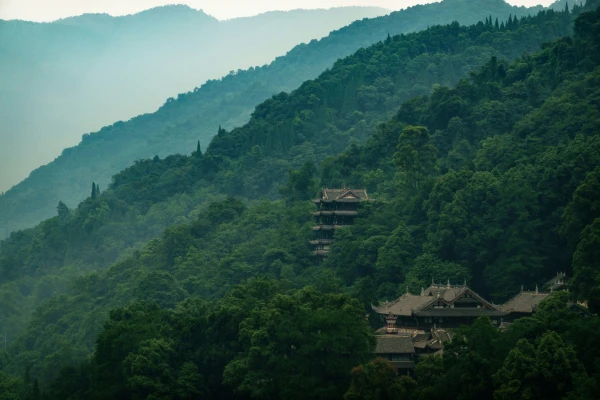
In recent decades, large-scale greening efforts in China have activated the water cycle in the country. In fact, they have managed to move groundwater in ways that scientists are only now beginning to understand, writes Focus.
A new study shows that China's efforts to slow land degradation and climate change through tree planting and grassland restoration have led to large-scale and unpredictable water redistribution across the country. Essentially, scientists are just beginning to understand how this works, writes Live Science.
According to the study, from 2001 to 2020, changes in vegetation cover led to a reduction in the amount of freshwater available to people and ecosystems in the eastern monsoon region and the northwest region, which together account for nearly 74% of China's territory. Scientists also found that during the same period, water availability increased in the Tibetan Plateau region of China, which makes up the remaining land area.
According to co-author of the study, Associate Professor of Ecosystem Sustainability at Utrecht University in the Netherlands, Ari Staal, he and his colleagues discovered that changes in soil-vegetation cover redistribute water. In simple terms, China's greening efforts have activated the natural water cycle.
It should be noted that the water between the continents of Earth and the atmosphere is mainly provided by three main processes:
Evaporation removes water from surfaces and soil, while transpiration removes water absorbed by plants from the soil. Together, these processes are called evapotranspiration, and it varies depending on vegetation cover, water availability, and the amount of solar energy reaching the ground.
According to Staal, grasslands and forests generally increase evapotranspiration. This is especially noticeable in forests, as trees have deep roots that access water during dry periods.
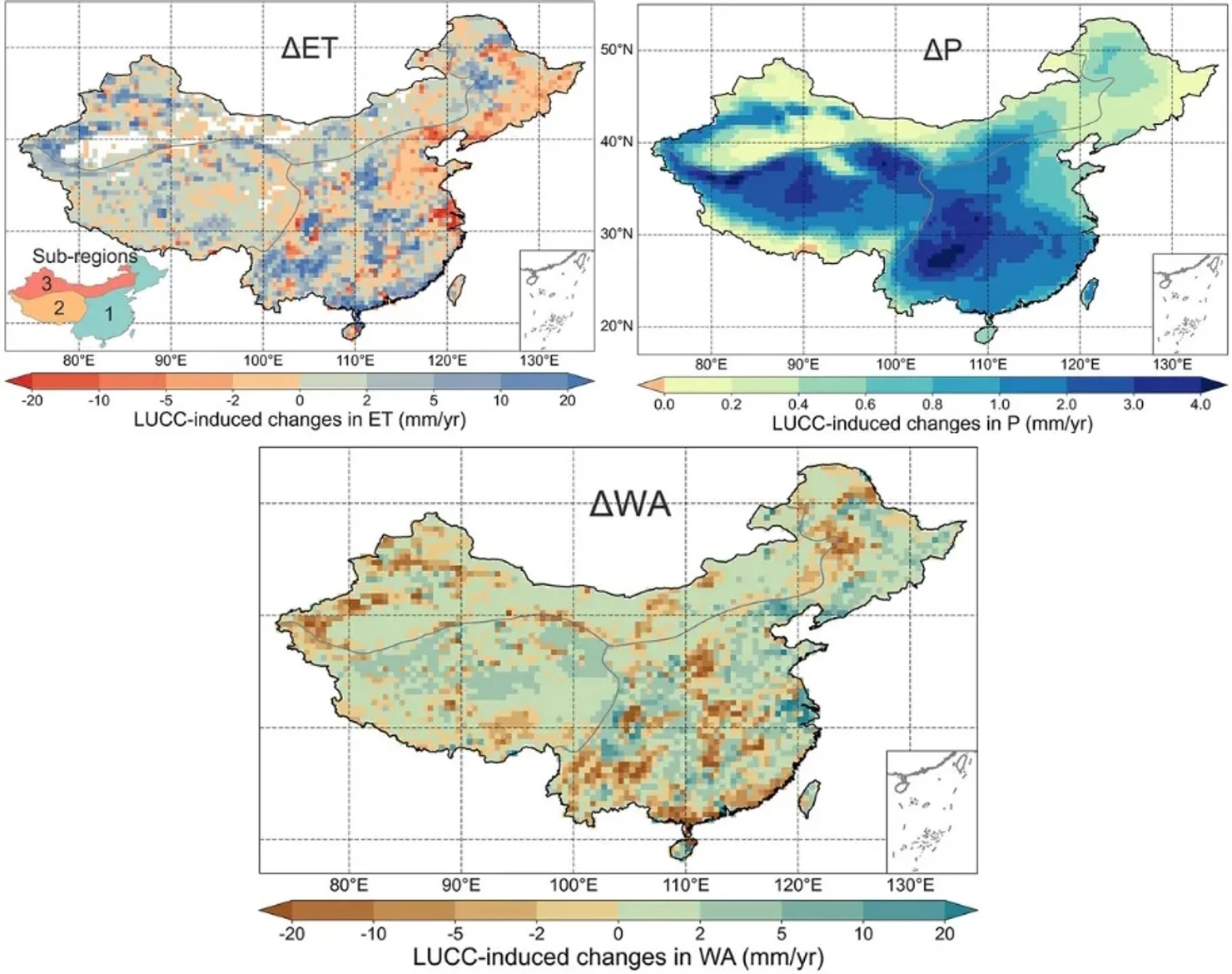
China's greening has led to huge changes in evapotranspiration (top left), precipitation (top right), and water availability (bottom) from 2001 to 2020
The authors note that China's largest tree planting project is the Great Green Wall in the arid and semi-arid north of the country. The Great Green Wall was created in 1978 and was intended to slow the expansion of deserts. Over the past 50 years, it has contributed to an increase in forest cover from about 10% of China's area in 1949 to more than 25% today. Last year, government representatives announced that the country had completed surrounding its largest desert with vegetation but would continue to plant trees to combat desertification.
However, this is not the only greening project. Together, China's ecosystem restoration initiatives account for 25% of the global increase in leaf area from 2000 to 2017.
Now scientists have also noticed that China's greening has actually radically changed China's water cycle, increasing both evapotranspiration and precipitation. In the new study, scientists used high-resolution data on evapotranspiration, precipitation, and land use change from various sources, as well as a model tracking atmospheric moisture.
The results showed that evapotranspiration overall increased more than precipitation — in simple terms, this means a loss of some water to the atmosphere. Interestingly, this trend was not uniform across China, as winds can carry water up to 7000 kilometers from the source, meaning that evapotranspiration in one place often affects precipitation in another.
As a result, scientists found that forest expansion in China's eastern monsoon region and grassland restoration elsewhere in the country led to increased evapotranspiration, but precipitation increased only in the Tibetan Plateau region. In other regions, water availability decreased. This has significant implications for water resource management, as China's water resources are already unevenly distributed.












Leave a comment