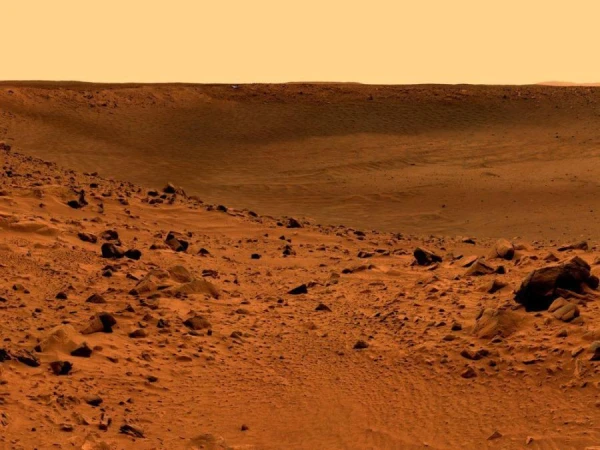
The study showed that the time difference between our planet and Mars will have important implications for future navigation and communication systems on the Red Planet, writes Focus.
Scientists have determined that time on Mars passes, on average, 477 millionths of a second faster per day than on Earth, thanks to Einstein's general theory of relativity. The study was published in The Astronomical Journal, writes Space.
Researchers calculated the time difference between Mars and Earth, taking into account the gravity on Mars, which is five times weaker than on Earth, the speed of movement, and the shape of the orbit of the Red Planet, as well as the gravitational influence of the Sun, Earth, and Moon.
According to Einstein's general theory of relativity, time can pass faster or slower for an observer depending on the reference frame they are in, which is determined by the speed of movement and gravity. This effect is called time dilation, which can lead to the twin paradox. It can occur if one twin astronaut travels into space on a ship moving nearly at the speed of light, while the other twin remains on Earth.
When the twin astronaut returns home, they will be younger than the twin who stayed on Earth because time passes slower the closer the spacecraft approaches the speed of light. Time also passes slower near a black hole, as it has stronger gravity than Earth.
Since Mars is farther from the Sun than Earth, it orbits our star more slowly, resulting in time passing more slowly on the Red Planet than on Earth. However, since Mars has a more elongated orbit than Earth, it speeds up slightly during its orbit around the Sun when it is a bit closer to our star and slows down when it is a bit farther away. The distance of Mars from the gravitational fields of the Sun and the Earth-Moon system also varies throughout the Martian year.
According to scientists, all of this leads to time on Mars passing faster than on Earth. While for an astronaut on Mars a second will last one second, for an observer on Earth that second on Mars will pass slightly faster compared to the second measured by the observer's clock on Earth. Although the average time difference between Mars and Earth is 477 microseconds per day, it can increase or decrease by 226 microseconds depending on Mars' position in its orbit relative to Earth and the Moon.
The time dilation on Mars is significant enough to potentially disrupt the operation of future navigation and communication systems on the Red Planet and around it. According to scientists, understanding the time difference between Mars and Earth can help synchronize GPS and communication systems between the two planets.
Previously, the authors of the study calculated the time difference on the Moon and Earth and found that time on the Moon passes 56 microseconds faster than on our planet.