For now, the station will only be supplied by the Americans.
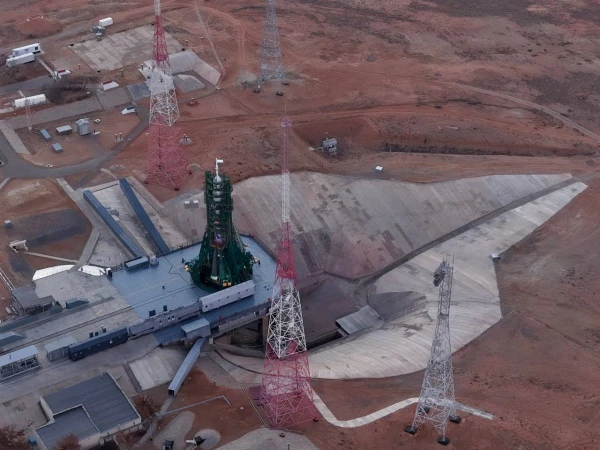
During the launch of astronauts to the ISS, the service cabin of launch complex No. 31 fell onto the launch pad. This means that new launches from there are impossible until repairs are completed. Unfortunately, in the 2010s, as part of cost "optimization," the backup launch pad (from which Yuri Gagarin flew) was decommissioned. Therefore, an unprecedented situation has occurred: in the 21st century, a country with a manned space program is left without means to launch people into orbit. Until the repairs are finished, the problem will persist. What could this lead to?
The service cabin is a multi-level structure that extends from the concrete wall of the gas duct (a structure that directs gases away from the rocket). It is in this cabin that part of the launch crew places special blocks on the rocket before launch, which are used to ignite the engines of the rockets developed by Korolev — namely, the "Soyuz" rockets, which are used to send both people and cargo spacecraft "Progress" into space. The latter, in turn, deliver cargo to manned orbital stations.
A lot of other things are done through the service cabin, but we won’t dwell on that. One thing is clear: if there are no blocks, the engines of the R-7 family rockets cannot be ignited. This is not a Falcon 9.
Consequently, the fall of the service cabin in the gas duct practically rules out the planned launch of the cargo spacecraft "Progress" to the ISS in December 2025. More importantly, it excludes any launch of Russian payloads to the ISS until significant work on the ground is completed. Any launch, including cargo. For now, the station will only be supplied by the Americans: other domestic cosmodromes are not ready for manned launches, and bringing them to that readiness will take longer than restoring launch complex No. 31.
"Roscosmos" relatively quickly announced that everything would be restored and that there are backup elements for such work. However, no specific timelines were provided. And there are significant reasons for this.
Firstly, no one has ever lost a service cabin in the history of astronautics. In 2018, during a launch from Vostochny, a cover protecting a similar cabin from rocket engine gases was blown off. But putting a cover back on is one thing, and making a new cabin is another.

Secondly, the 8U216 service cabin is no longer a serial product. After all, the intercontinental ballistic missile R-7, for which it was once put into operation, has long been out of active duty. And for civilian astronautics, no one planned to build a series of such products. From the example of American astronautics, it is known that a space product from a past era cannot be quickly built today: the necessary sizes (literally down to the bolts) are no longer available, and sometimes the required alloys are no longer produced.
Therefore, the "backup elements" mentioned in Roscosmos's message can be simply decoded: next to launch complex No. 31, where the cabin fell, there is launch complex No. 1. Yuri Gagarin once flew from there, but in the 2010s, as part of "optimization," it was decommissioned.
Unlike Musk with his private company, where dogs freely roam the cosmodrome, one cannot just take, cut here, move there, and assemble in a few weeks at Roscosmos, because it is a government institution. A tender will need to be conducted for the work. Documentation will need to be prepared for it. Anyone who has worked in budget institutions immediately understands that this cannot be done quickly. It would be good if the purely paperwork part of the work is completed in a couple of months...